Lesson 6 January 31-February 6
Confidence Only in Christ
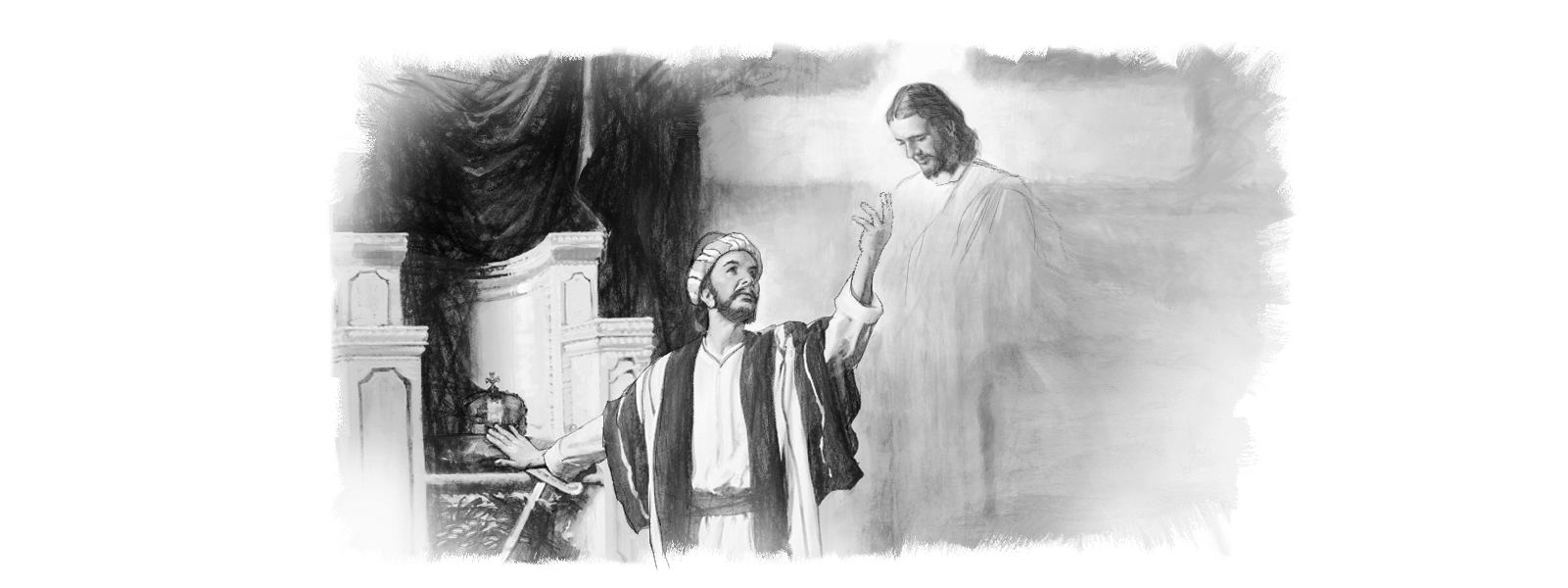
Sabbath Afternoon
Read for This Week's Study: Phil. 3:1-16; Rom. 2:25-29; John 9:1-39; Eph. 1:4, 10; 1 Cor. 9:24-27
Memory Text: "That I may know Him and the power of His resurrection, and the fellowship of His sufferings, being conformed to His death, if, by any means, I may attain to the resurrection from the dead" (Philippians 3:10-11, NKJV).
There's something about us that remains suspicious about salvation by faith alone, apart from the works of the law. That is, for some reason, we all tend to lean on our works, as if they could add to our salvation. In a rather striking way, Paul deals with this point in a vigorous polemic against those who insist that circumcision is necessary for salvation.
To guard against the possibility that some might consider their works, such as circumcision, as contributing to their salvation, Paul makes it clear that righteousness is from Christ as a gift that comes by faith, not by the law. Though circumcision might not be an issue today, the principle it deals with certainly is.
The Protestant Reformation itself started over this very issue: the role of faith and works in the experience of a follower of Christ. In the end, Christ is everything to us, "the author and finisher of our faith" (Heb. 12:2). If our priorities are in the right place, we will live with the assurance of God's love and enjoy the promise, even now, of salvation, all while placing "no confidence in the flesh" (Phil. 3:3).
* Study this week's lesson to prepare for Sabbath, February 7.
Rejoicing in the Lord
Read Philippians 3:1-3. What positive and negative notes does Paul sound here, and how are they related? How does he describe believers?
Paul begins on a very positive note and almost sounds as though he is wrapping up his letter. But he's not done. He returns to one of the main themes of this epistle: rejoicing in the Lord. And he will give a number of reasons for that here. Most important, we are to have confidence in Christ, not in ourselves: "We ... rejoice in Christ Jesus, and have no confidence in the flesh" (Phil. 3:3). Who among us has, in one way or another, learned the hard way about not putting confidence in the flesh?
The strong warning "Beware" (three times) is not found anywhere else in Scripture. Apparently, the Philippians knew very well what threat Paul was referencing. Rather than three separate problems, the warning appears to refer to a group of false teachers described in three different ways.
Wicked or irreligious people in Israel were sometimes referred to as "dogs" (Phil. 3:2; compare Ps. 22:16; Isa. 56:10; Matt. 7:6; 2 Pet. 2:21-22). False teachers could also aptly be described as "evil workers." Referring to them as "the mutilation" (Phil. 3:2, NKJV) or "those who mutilate the flesh" (ESV) shows that, as in Galatia and other locales, they were seeking to impose circumcision on Gentile believers, contrary to the ruling of the Apostolic Council (see Acts 15).
Interestingly, it seems that one solution to spiritual challenges, including the spread of false teachings, is to "rejoice in the Lord" (Phil. 3:1; compare Phil. 4:4).
Anything we rejoice about brings us joy (as in English, the two Greek words for these ideas are related). God wants us to be joyful, and His Word is a kind of instruction manual for true happiness and lasting joy. These include receiving God's mercy (Ps. 31:7); placing our trust in Him (Ps. 5:11); receiving the blessings of salvation (Ps. 9:14); adopting God's law as our way of life (Ps. 119:14), including the Sabbath (Isa. 58:13-14); believing His Word (Ps. 119:162); and raising godly children (Prov. 23:24-25).
Life can be very difficult for us all, no matter how well things might be going at the moment. But even if they are not going well now, what things can you and should you rejoice about? What is stopping you from doing it?
Paul's "Past Life"
It is a common experience for Christian converts to think of their lives in terms of before they accepted Jesus and after, just as Paul does in Philippians 3. Nevertheless, rightly or wrongly, we sometimes speak of those who are not Christians as being "good people," and, at least according to the world's standards, many indeed are. In contrast, compared to God's standards, no one is, not even Christians.
In Philippians 3:4-6, Paul points to many things in his life of which he had once been proud. What are they? How would you describe the "good" in your own life (past and present)?
Paul makes an implicit contrast between believing Jews who are spreading false doctrine and uncircumcised believers who rely fully on Christ for their salvation and put no confidence in mere human works such as circumcision (see Heb. 6:1, Heb. 9:14; compare Rom. 2:25-29). Even though Paul's past life and pedigree would have been quite impressive to his fellow Jews, none of these things contributed to his salvation. In fact, they actually hindered it because they blinded him for a while to his need of Christ.
Paul was not just circumcised--he was an "eighth day-er," meaning he, an Israelite by birth and belonging to the people of the covenant, was circumcised on the eighth day. Furthermore, he was from the tribe of Benjamin, whose territory included some of the most important cities of Israel. Paul not only knew Hebrew but, as a student of Gamaliel the Elder (Acts 22:3, Acts 26:4-5) and a Pharisee, he would have been steeped in knowledge of the law and how it was, at least according to tradition, to be applied.
Paul was so zealous for the law that he persecuted the church because of its perceived threat to the Jewish way of life, which he thought the law prescribed. Interestingly, though "blameless" in terms of that human-originated "righteousness," Paul realized the law was actually far deeper and more demanding than he could imagine, and that without Christ he stood before it condemned.
Compare Romans 7:7-12 with Matthew 5:21-22, 27, 28. What crucial point do both Jesus and Paul make about the law, and why is "faith in Christ" (Phil. 3:9, NKJV), rather than the law, the only source of righteousness? Look at it this way: How well do you keep the law, at least in the way Jesus said we should?
The Things That Matter
As yesterday's study pointed out, the things that previously made Paul proud were actually hindrances to faith because they blinded him to his need of Christ. Paul uses the language of commerce, gain and loss, to describe his spiritual ledger prior to faith. Although we don't like to think about it much, every human being has a "spiritual ledger." Previously, Paul's ledger was measured by the Jewish values of the time rather than by the biblical values as taught by Jesus.
After his conversion, his spiritual ledger looked very different because its scale of values dramatically changed, from the "currency" of Judaism to the "currency of heaven."
"He who came down from heaven can speak of heaven, and rightly present the things which form the currency of heaven, on which he has stamped his image and superscription. He knows the danger in which those are placed whom he came to uplift from degradation, and to exalt to a place beside himself upon his throne. He points out their peril in lavishing affection upon useless and dangerous objects. He seeks to draw the mind away from the earthly to the heavenly, that we may not waste time, talent, and opportunity, upon things that are altogether vanity."--Ellen G. White, in The Advent Review and Sabbath Herald, July 1, 1890.
In the world of first-century Judaism, Paul had been a rapidly rising star until, by becoming blind at the sight of the glorified Jesus on the Damascus road (Acts 9), his spiritual eyesight was corrected, and he saw clearly.
John 9 tells the story of another man who was blind and then saw Jesus clearly. Jesus said He came into the world so "that those who do not see may see, and that those who see may be made blind" (John 9:39, NKJV). How might this principle be applied to your own life?
What could be more valuable than eternal life in heaven and on the new earth? Yet worldly values blind so many to this reality. There is an inherent competition between the things valued here (see Matthew 13:22; Luke 4:5-6; 1 John 2:16) and the things Heaven values—likeness to Christ and souls saved.
The world can blind us to spiritual truths and to what is really important. What is the key to keeping our eyes focused on what truly matters?
The Faith of Christ
Paul's main point must not be missed. There was a wonderful exchange that he experienced on the Damascus road, trading his old, law-based life for the presence of Christ Himself--"that I may gain Christ and be found in Him" (Phil. 3:8-9, NKJV).
To be found "in Him," that is, in Christ, is an interesting expression. Read Ephesians 1:4, 2 Corinthians 5:21, Colossians 2:9, and Galatians 2:20. Based on these passages, what do you think Paul means by this idea?
Paul's reference to being in Christ has been widely discussed. Not surprisingly, perhaps the best explanation of it comes from Paul himself: "That in the dispensation of the fullness of the times He might gather together in one all things in Christ, both which are in heaven and which are on earth--in Him" (Eph. 1:10, NKJV). That has been God's purpose from the start. And Paul makes clear how that happens: "You are in Christ Jesus, who became for us wisdom from God--and righteousness and sanctification and redemption" (1 Cor. 1:30, NKJV).
Being "in Christ" comprehends everything that the plan of salvation encompasses, from the dawning of our spiritual intelligence (wisdom), to justification by faith (righteousness), to preparation for heaven (sanctification), and finally to glorification at the Second Advent (redemption). Salvation is Christ's work from start to finish--for us and in us. Thus, by gaining Christ, we have everything we need.
Read Philippians 3:9. What two things does Paul contrast, and why is this contrast important to always remember?
As Paul came to realize, having one's "own righteousness" is not real righteousness because the law cannot give life (see Gal. 3:21-22); only Christ can, through faith. And not just any faith. After all, the devils believe and tremble (James 2:19). The only saving faith is "the faith of Christ." Only His faith has obeyed fully and can obey. (The Greek word for faith, pistis, also means faithfulness.) So, if we are in Christ and He lives in us (Gal. 2:20), then we live by His faith through our faith in Him.
Just One Thing--Knowing Christ
Read Philippians 3:10-16. What are some of the main points Paul makes in this passage?
Surely there is nothing more important than knowing Christ, which guarantees in the end that He will know us and acknowledge us before the Father (see Matt. 7:21-23; Matt. 10:32-33). How do we know Him? Through His Written Word--reading it and living it. We cannot know Him face to face as the disciples did. But interestingly, despite that knowledge, they still failed to comprehend His words, underscoring our need of the Holy Spirit to guide us (see John 16:13). The more we know Him, the closer we come to Him, because we experience "the power of His resurrection" (Phil. 3:10), which raises us to "newness of life" (Rom. 6:4, NKJV).
Another way we come closer to Jesus is through "the fellowship of His sufferings" (Phil. 3:10, NKJV). Every trial faced, every painful experience borne, helps us to know and appreciate more what Jesus went through for us, and also to understand Him and His will more clearly.
A third way we come closer is by pressing onward "toward the goal" (Phil. 3:14, NKJV). What is that goal? It translates a word used only here in the New Testament (skopos). It refers to the finish line of a race and the prize awarded the victor. Paul calls it "the prize of the upward call of God in Christ Jesus" (Phil. 3:14, NKJV). Just as Christ, through His death and resurrection, ascended upward to heaven, God invites us to receive the same heavenly reward--eternal life.
Obviously, we have not attained that yet. We will not be perfected in the fullest sense until our "lowly body" is transformed "that it may be conformed to His glorious body" (Phil. 3:21, NKJV). But by knowing Him and inviting His presence into our lives every day, we press on toward the goal of being like Jesus in every way possible now. This is the "one thing" Paul focused on, too. Just like running a race (see 1 Cor. 9:24-27), we pay no attention to where we've been or who trails us. Our single focus is on the things that lie ahead--that heavenly prize that awaits us. The image here is vivid: a runner's full focus on the goal, straining every muscle and leaning forward to reach the finish line.
Why, in your walk with the Lord, is it so important to not keep looking back, at least back at your sins and failures, but instead to look ahead to what you have been promised right now in Christ?
Further Thought: "He who would build up a strong, symmetrical character, he who would be a well-balanced Christian, must give all and do all for Christ; for the Redeemer will not accept divided service. Daily he must learn the meaning of self-surrender. He must study the word of God, learning its meaning and obeying its precepts. Thus he may reach the standard of Christian excellence. Day by day God works with him, perfecting the character that is to stand in the time of final test. And day by day the believer is working out before men and angels a sublime experiment, showing what the gospel can do for fallen human beings."--Ellen G. White, The Acts of the Apostles, p. 483.
"Those who wait for the Bridegroom's coming are to say to the people, 'Behold your God.' The last rays of merciful light, the last message of mercy to be given to the world, is a revelation of His character of love. The children of God are to manifest His glory. In their own life and character they are to reveal what the grace of God has done for them.
"The light of the Sun of Righteousness is to shine forth in good works--in words of truth and deeds of holiness."--Ellen G. White, Christ's Object Lessons, pp. 415, 416.
Discussion Questions:
- Dwell more on this question of rejoicing in the Lord. Notice that it is not saying to rejoice in your trials (though that's biblical too) but in the Lord. Why is it so important to always keep before us the Lord, His goodness, His power, His love, and His salvation? How would doing that greatly benefit you amid the inevitable trials of life?
- Notice how the above quotations describe the role of grace in producing the "good works" we do as Christians. Why is this function of grace so important as we look forward to the soon coming of Christ? That is, though we are not saved by good works, are we really saved if we don't have them?
- Dwell more on this idea of not having confidence in the flesh. What does that mean? Why should we not have confidence in it? Is not our flesh a gift from God?

Gilbert Fimaka
Gilbert Fimaka
Unexpected Church Visit
Gilbert Fimaka woke up on a Sunday with a strong desire to go to church.
The 22-year-old medical missionary shared his longing with his roommate, a fellow medical missionary. The two young men were just wrapping up a three-week mission trip in rural Zambia.
"I'm thinking about visiting a church here," Gilbert said. "I'd like to share the Word of God and also tell them about the seventh-day Sabbath."
Then he laughed. His roommate also laughed. The idea seemed preposterous. But in his heart, Gilbert wanted to go. So, he went.
As he entered the closest church, he felt nervous. He knew that he couldn't just say, "This is not the day of worship."
To his surprise, the church members quickly made him feel at home. Many recognized him from his medical work, and they welcomed him warmly. They even gave him a seat of honor with the church leaders.
Then it was time for the sermon. To Gilbert's surprise, he was invited to preach. He felt humbled as he approached the pulpit, but he was scared to talk about the Sabbath. So, he opened his Bible to the book of Job.
As Gilbert spoke, he heard a voice say, "Talk about the Sabbath." He ignored it and continued preaching. The voice spoke a second time. When the voice spoke a third time, Gilbert turned in his Bible to Leviticus 23:3 and read, "Six days shall work be done, but the seventh day is a Sabbath of solemn rest, a holy convocation. You shall do no work on it; it is the Sabbath of the Lord in all your dwellings" (NKJV). Then he read Matthew 28:1 and Genesis 2:1-3.
"The seventh day does not fall on a Sunday but on a Saturday, so the true day of worship is not Sunday but Saturday," he said.
When he finished the sermon, a church leader stood up and announced, "I will stop worshiping on Sunday and only worship on Saturday."
As people left the church, many talked loudly. Some were weeping. "We didn't know that we were worshiping on the wrong day," said one. "From now on, we will worship on Saturday," said another.
A short time later, the church leader was baptized in a Seventh-day Adventist church, and many other church members begun studying the Bible in preparation for baptism.
This mission story illustrates the "Mission For All" objective of the Seventh-day Adventist Church's "I Will Go" strategic plan, which says in part, "Christ mingled, showed sympathy, ministered to needs, won confidence, then invited people to follow Him. The goal is to take a genuine interest in people, leading them to Christ and inviting them to unite with the Seventh-day Adventist Church as disciples of Christ who make disciples." Read more at IWillGo.org.
Sabbath School Net is a volunteer ministry independent of the General Conference Sabbath School Department.
For questions and concerns about the Adult Bible Study Guide,
please contact the editor of the Bible Study Guide, Clifford Goldstein
The web version of the Sabbath School lesson is published on
this site by permission of the Office of the Adult Bible Study Guide, General Conference of Seventh-day Adventists.
Website contents copyright 1996-2025 by Sabbath School Net, an independent supporting ministry.
For permission to copy contents of the web version of the Sabbath School lesson, please contact both the Office of the Adult Bible Study Guide and the publisher of this site.
All art in these lessons and on the cover is published on this site by permission of
GoodSalt.com.

We invite you to join a discussion of this lesson each day on the Sabbath School Net Daily
Lessons blog. And on Sabbath mornings, you are warmly invited to join a group discussion of the week's lesson in your local Seventh-day Adventist congregation. If you do not know where to find your nearest Seventh-day Adventist Church, you can check out the
Seventh-day Adventist church locator.
Sabbath School Net is a supporting website not affiliated with nor funded by the Sabbath School Department of the General Conference of Seventh-day Adventists)It is run by volunteers and costs are covered solely by donations from the users of this site as well as the small commissions generated by sales through our links to online stores.

If you are using this site regularly, please pray for God's blessing on our visitors. Please also ask Him to impress you how you can help with the costs of putting this site up every month. We appreciate any gift to support the ongoing publication of Sabbath School Net, and only you and God know how much you can give. Even a small donation every month helps. And larger gifts are much appreciated. (No, you don't need a PayPal account. Just choose the "Continue" link to the left of the PayPal registration. And, yes, it's safe - as safe as your online bank account.)
Sabbath School Net
You can find a sampling of materials available to aid you in your studies at our Sabbath School Net "Store." (We will get a small commission not only from any books you purchase but also from whatever else you purchase at the same time. These commissions help to underwrite a small portion of the cost of publishing this site.)
You can also go directly to the home pages of stores which will pay us a small commission for whatever you choose to buy, without costing you a penny extra: Amazon.com | AbeBooks Store
Sabbath School Net Home page | Directory of Sabbath School Bible Study materials
Looking for an older lesson? You will likely find it in our Lesson Archives
Contact the Sabbath School Net Web Team
Go back to top of page