Lesson 5 January 24-30
Shining as Lights in the Night

Sabbath Afternoon
Read for This Week's Study: Phil. 2:12-30; Rom. 3:23-24; Rom. 5:8; 2 Tim. 4:6; 1 Cor. 4:17; 2 Tim. 4:21, 13; Luke 7:2
Memory Text: "Do all things without complaining and disputing, that you may become blameless and harmless, children of God without fault in the midst of a crooked and perverse generation, among whom you shine as lights in the world" (Philippians 2:14-15, NKJV).
God told the Hebrews to obey because that obedience "is your wisdom and your understanding in the sight of the peoples who will hear all these statutes, and say, 'Surely this great nation is a wise and understanding people'" (Deut. 4:6, NKJV).
Centuries later Jesus said, "I am the light of the world. He who follows Me shall not walk in darkness, but have the light of life" (John 8:12, NKJV). He has also said, " 'You are the light of the world. A city that is set on a hill cannot be hidden' " (Matt. 5:14, NKJV). How can we be that light? Only through a close connection with Jesus, "the true light that gives light to everyone" (John 1:9, NIV). As Philippians 2 says, God "has highly exalted Him and given Him the name which is above every name, that at the name of Jesus every knee should bow ... and that every tongue should confess that Jesus Christ is Lord" (Phil. 2:9-11, NKJV).
The light and power of heaven is available to all of us who have surrendered our lives to Jesus. But too often either we expect God to do it all or our own ideas and plans get in the way. That's why Paul's words to the Philippians are so relevant today.
* Study this week's lesson to prepare for Sabbath, January 31.
We Work Out What God Works In
Having just presented Jesus as the perfect example of humility and obedience to God's will, Paul now turns to the Philippians themselves. He affirms their obedience to the Lord after they received the gospel message (see Acts 16:13-15, 32, 33) and urges them to continue in that obedience.
Having presented the example of Christ's life and the cross as the way of salvation, Paul now focuses more directly on how this all works in practice.
Read Philippians 2:12-13. What does Paul mean by saying, "Work out your own salvation"? How would you describe the relation between faith and works?
In these two verses, Paul does not present a different gospel from what he outlines in Romans and in his other epistles. We can be sure his message here agrees with the gospel of justification by faith, which he also preached in Philippi and other places. But it's also important to consider all the Bible says on a given topic, especially on the topic of salvation, which can be so misunderstood.
Read Romans 3:23-24; Romans 5:8; and Ephesians 2:8-10. What do these passages teach about salvation?
Without question, salvation is God's work, and we can take absolutely no credit for it ourselves. Even faith itself is a gift, encouraged through the work of the Holy Spirit. Our own works cannot save us; however, through the new birth, God re-creates us spiritually, enabling us to do good works. God's Spirit works in us, empowering our will to choose the right, to resist temptation, and to make right choices.
Thus, we work out what God works in, "with fear and trembling" (Phil. 2:12). Does that mean we should be afraid of God's judgment on our often feeble efforts to obey? Of course not. This phrase refers to sensing God's presence (see Ps. 2:11) and our need to obey Him.
In what ways have you experienced Christ working in you? How, though, does your fallen nature fight against what God is doing in you, and how can you resist that pull?
Light in a Dark World
In Philippians 2:14, Paul urges the Philippians to "do all things without complaining and disputing" (NKJV). The challenges to church unity are so serious that it cannot be maintained without significant effort on our part. Unity within the church is a byproduct of our union with Christ and obedience to His Word. And it's vital to our witness, as Paul proceeds to point out, calling us to "shine as lights in the world" (Phil. 2:15).
On a moonless night, away from the glare of cities and street lights, more stars are visible, and they seem to shine much more brightly. It's the contrast that makes the difference. The blacker the sky, the more clearly the stars stand out. It's the same with our witness. The greater the moral darkness around us, the starker the contrast between the lives of God's true followers and that of worldlings. How important it is, then, not to let the artificial lights of worldly ideas, pressures, and practices cause our witness to fade into the background or to disappear entirely.
Read Philippians 2:15-16. How does Paul describe what we, as children of God, are to be and to do?
"Blameless" means "faultless, without reproach." It is used especially of Job and his blameless character (see Job 1:1, 8, NKJV; Job 2:3, NKJV; see also Job 11:4; Job 33:9). The Greek word translated "harmless" literally means "unmixed, pure." Jesus, in view of the vicious attacks that His witnesses are likely to face, encourages us to be "harmless as doves" (Matt. 10:16). Paul similarly urges us to be "simple concerning evil" (Rom. 16:19, NKJV). Our modern media channels are not known for pure, uplifting, and inspiring content. In times like these, David's practice is a great rule for us today: "I will set no wicked thing before mine eyes" (Ps. 101:3).
We should never fear being different--our faith should increasingly set us apart. The goal is to "shine as lights in the world" (Phil. 2:15). The only way to do that is to reject conformity to this world (Rom. 12:2) by "holding fast the word of life" (Phil. 2:16, NKJV). Our choices determine whether we have lived with "the day of Christ" in view or have "run in vain" (Phil. 2:16, NKJV; compare 1 Cor. 9:24-27).
If there are areas of your life that you would consider "worldly" (and there probably are), how can you be cleansed from them?
A Living Sacrifice
Read Philippians 2:17; 2 Timothy 4:6; Romans 12:1-2; and 1 Corinthians 11:1. What is Paul saying in these passages?
Paul has already expressed a surprisingly ambivalent view toward whether he lives or dies in service to Christ (Phil. 1:20-23). Now he suggests the very real possibility of "being poured out as a drink offering" (Phil. 2:17, NKJV). This imagery is based on the ancient practice of libations, which involved pouring out a liquid (such as oil, wine, or water) as an offering to God (see, for example, Gen. 35:14, Exod. 29:40, 2 Sam. 23:15-17). The apparent "waste" of a valuable liquid in an act of devotion may remind us of Mary's act of anointing Jesus' head and feet with the "very costly oil of spikenard" (Mark 14:3-9, NKJV; John 12:3, NKJV). While not a drink offering per se, it clearly represented an enormous sacrifice that fittingly illustrated the infinite sacrifice of Christ for our salvation.
Should Paul be executed for his work of spreading the gospel, he would rejoice because his life was being "poured out" as an offering to God. Because libations in the Hebrew Bible generally do not stand alone but accompany a sacrifice (see Num. 15:1-10, Num. 28:1-15), Paul would consider the giving of his life as the fitting complement to the "sacrifice and service" of believers in Philippi, who, through faith, have chosen to devote their lives to God as a "living sacrifice" (Rom. 12:1).
The early Christians, including those in Philippi (Phil. 1:27-29), were active in sharing their faith. They went spreading the gospel from house to house (Acts 5:42). They opened their homes for the study of the Scriptures (Acts 12:12; 1 Cor. 16:19; Col. 4:15; Philem. 1, 2), and were able to give reasons from the Scriptures for what they believed (Acts 17:11, Acts 18:26, 1 Pet. 3:15). Our Adventist pioneers did the same. Rather than relying on pastors to spread the message to their neighbors, they shared their faith, gave Bible studies, and prepared people so they would be ready for baptism when the minister returned.
In short, at great personal sacrifice to themselves, that is, as a "living sacrifice," they worked to spread the gospel. Should we do any less?
Reflect on what it would mean for your life to be a "living sacrifice." How much do you sacrifice for the kingdom of God, and what does your answer tell you about yourself?
Proven Character
Timothy's role as a co-sender of this epistle has already been mentioned (Phil. 1:1). Now Paul begins to detail how valuable Timothy is as one of his coworkers. He is described as an evangelist (2 Tim. 4:5) whom Paul had sent to Macedonia (1 Thess. 3:2; compare Acts 18:5, Acts 19:22) and, on several occasions, to Corinth (1 Cor. 4:17, 1 Cor. 16:10). Previously he had worked with Paul and Silas in Corinth (1 Thess. 1:1, 2 Thess. 1:1) and, later, in Ephesus (1 Tim. 1:2-3; compare Acts 19:22). Paul describes Timothy as being "like-minded" (Phil. 2:20, NKJV). The Greek word (lit. "equal in soul") suggests he was like Paul in many ways, including his commitment to Christ, his energetic efforts to spread the gospel, and his concern for the Philippians specifically.
Why do you think Paul speaks so positively and at such length about Timothy here (see Phil. 2:19-23)? What else does Paul say about him (see 1 Cor. 4:17, 2 Tim. 1:5)?
Another quality of Timothy's mentioned by Paul is his "proven character" (Phil. 2:22, NKJV). The Greek word describes a person who has been thoroughly tested by trials (Rom. 5:4) and whose character and service has proved to be genuine (2 Cor. 2:9, 2 Cor. 9:13). Paul knows this to be true of Timothy because he has seen it demonstrated through the many occasions that they worked alongside each other in spreading the gospel.
It is the difficult experiences of life that test our mettle and demonstrate who we are on the inside. Ellen G. White puts it this way: "Life is disciplinary... There will be provocations to test the temper; and it is by meeting these in a right spirit that the Christian graces are developed. If injuries and insults are meekly borne, if insulting words are responded to by gentle answers, and oppressive acts by kindness, this is evidence that the Spirit of Christ dwells in the heart." --Testimonies for the Church, vol. 5, p. 344. She goes on to say that if "the hardships and annoyances that we are called to bear" are "well endured, they develop the Christlike in the character and distinguish the Christian from the worldling." --Testimonies for the Church, vol. 5, p. 344.
Think about the provocations, hardships, and annoyances you have faced recently. Have these been "meekly borne" and "well endured"? What can you do to enable these experiences to help make you more disciplined?
"Hold Such Men in Esteem"
Read Philippians 2:25-30. How does Paul describe Epaphroditus? What specific attitudes and actions of this Christian worker reveal his character?
Epaphroditus is mentioned only in this letter, but we learn quite a bit about him from the few brief mentions that appear. Judging from his name (which refers to the cult of Aphrodite), he was converted from a pagan background. Calling him a "fellow worker" suggests he was active in ministry, perhaps working alongside Paul in Philippi. Being a "fellow soldier" (compare Phil. 1:27) probably refers to conflict Epaphroditus faced in spreading the gospel, willing even to risk his life (Phil. 2:30).
As the "messenger" (Greek: apostolos) appointed by the church in Philippi, Epaphroditus is sent to minister to Paul in prison and to care for any other needs he may have (Phil. 2:25). He was the one the Philippians entrusted with their financial gifts for Paul (Phil. 4:18). These offerings were critically important because whatever food, clothing, bedding, or other necessities Roman prisoners might need would have to be purchased at their own expense or brought to them by family and friends (compare Acts 24:23). Near the end of his second imprisonment in Rome, Paul asked Timothy to "do your utmost to come before winter" and "bring the cloak" left at Troas (2 Tim. 4:21, 13, NKJV). Paul would apparently need this thick, woolen overcoat in his cold, stone cell. It was also Epaphroditus who was entrusted with carrying this epistle back to Philippi (see Ellen G. White, The Acts of the Apostles, p. 479).
Perhaps because of the problems in Philippi (see Lesson 4), Paul "considered it necessary" to send Epaphroditus back sooner than anticipated, and thus urges the Philippians to "welcome him in the Lord with great joy" (Phil. 2:29, NIV). Paul wants to make sure they do not worry about his own situation in jail. He also underscores that Epaphroditus is the kind of person Christians are to hold in high esteem, not because of their wealth or social status but because of their sacrificial spirit in following the example of Jesus (Phil. 2:6-11, 29, 30; compare Luke 22:25-27). The Greek word for esteem or honor appears only a few times in the New Testament: for the centurion's servant who was "valued highly" (Luke 7:2, NRSV), for those who are shown honor by their placement at a feast (Luke 14:8), and of Jesus as the "precious" cornerstone (1 Pet. 2:4, 6). For Epaphroditus to be included in that group, he must have been, indeed, a faithful man.
Further Thought: "The one who stands nearest to Christ will be he who on earth has drunk most deeply of the spirit of His self-sacrificing love,--love that 'vaunteth not itself, is not puffed up, ... seeketh not her own, is not easily provoked, thinketh no evil' (1 Corinthians 13:4-5),--love that moves the disciple, as it moved our Lord, to give all, to live and labor and sacrifice, even unto death, for the saving of humanity. This spirit was made manifest in the life of Paul. He said, 'For to me to live is Christ;' for his life revealed Christ to men; 'and to die is gain,'--gain to Christ; death itself would make manifest the power of His grace, and gather souls to Him. 'Christ shall be magnified in my body,' he said, 'whether it be by life or by death.' Philippians 1:21, 20."--Ellen G. White, The Desire of Ages, p. 549.
"The time is not far distant when the test will come to every soul. The mark of the beast will be urged upon us. Those who have step by step yielded to worldly demands and conformed to worldly customs will not find it a hard matter to yield to the powers that be, rather than subject themselves to derision, insult, threatened imprisonment, and death...
"When multitudes of false brethren are distinguished from the true, then the hidden ones will be revealed to view, and with hosannas range under the banner of Christ. Those who have been timid and self-distrustful will declare themselves openly for Christ and His truth. The most weak and hesitating in the church will be as David--willing to do and dare. The deeper the night for God's people, the more brilliant the stars. Satan will sorely harass the faithful; but, in the name of Jesus, they will come off more than conquerors." --Ellen G. White, Testimonies for the Church, vol. 5, pp. 81, 82.
Discussion Questions:
- Think about the warning in the above quote about those who "step by step yielded to worldly demands and conformed to worldly customs." What might that include? Discuss how this might apply not only to individuals but to the church as a whole.
- God says, " 'Those who honor Me I will honor' " (1 Sam. 2:30, NKJV). In what ways do we honor God? Is it the same as to "give glory to Him" (Rev. 14:7, NKJV)? Why, or why not?
- How can we understand the concept of working out our own salvation without falling into the trap of legalism?
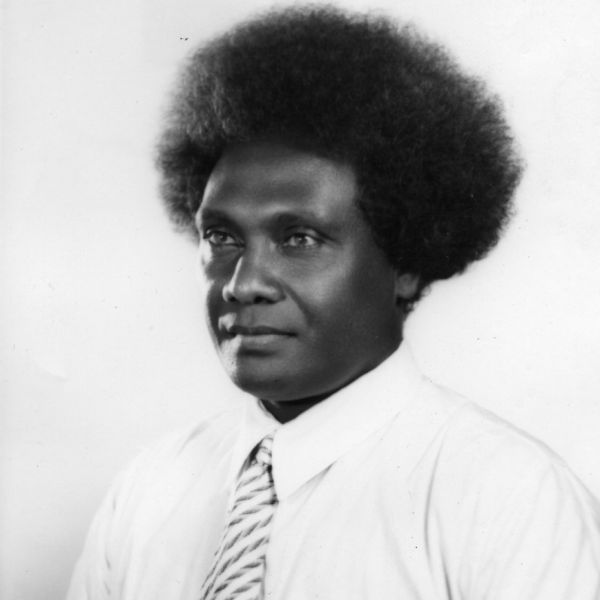
Kata Ragoso
Kata Ragoso
No Devil Strings
Marovo Lagoon tribesmen were considered the most warlike and cannibalistic of the Solomon Island tribes. They worshiped the spirits of their ancestors, whose skulls were kept after death. They lived in fear of the devil.
But around 1902, a Marovo chief named Tatagu began to wonder if he really needed to fear the devil. He decided to find out and not to attach a vine to the prow of his canoe on a fishing expedition. Vines were supposed to appease the devil and ensure a good catch. Without the vine, the fishing trip was a huge success. Chief Tatagu returned home to find a newborn son. He named the boy Kata Ragoso, which means "no devil strings."
Kata Ragoso's life would go on to reveal God's power to transform a community and remove the strings and ties that the devil had over people.
Kata Ragoso grew up at a time when dishonest European traders enticed Solomon Islanders into their ships with foreign goods to kidnap them as slaves. But in 1914, when Kata Ragoso was about 12, a small white boat called the Advent Herald sailed into Marovo Lagoon. The crew didn't try to entice or kidnap. Instead, Captain Griffiths F. Jones asked Chief Tatagu for land for a school. The next year, a school was built at Sasaghana, and Kata Ragoso enrolled as one of its first 23 students. At the school, he accepted Jesus and was among the first 10 Solomon Islanders to be baptized in 1918. He went on to work as a mission teacher, translator, and printing press operator. In 1935, he was ordained as an Adventist minister.
During World War II, Kata Ragoso was placed in charge of the Adventist work in the Solomon Islands. When the Japanese army invaded, they ordered him to kill people with white skin and from the Allied forces. For declaring that he would rather obey God than man, he was interrogated, flogged, and ordered shot. The interrogating officer, who had a strong dislike for the Adventist Church, instructed the firing squad to shoot at the count of three. He counted, "One, two ..." but was unable to say "three." He tried many times before giving up. After 10 days in prison, Kata Ragoso escaped. For the rest of the war, he led a rescue operation for Allied soldiers whose planes or ships were attacked. He rescued 27 U.S. pilots and 187 Australian and New Zealand soldiers.
Kata Ragoso died in 1964 at age 62, having served the church for 37 years. During that time, he saw the Marovo transformed from a warring community into a merciful people serving God.
This quarter's Thirteenth Sabbath mission projects are in the South Pacific Division, whose territory includes the Solomon Islands. Thank you for planning a generous offering on March 28.
Sabbath School Net is a volunteer ministry independent of the General Conference Sabbath School Department.
For questions and concerns about the Adult Bible Study Guide,
please contact the editor of the Bible Study Guide, Clifford Goldstein
The web version of the Sabbath School lesson is published on
this site by permission of the Office of the Adult Bible Study Guide, General Conference of Seventh-day Adventists.
Website contents copyright 1996-2025 by Sabbath School Net, an independent supporting ministry.
For permission to copy contents of the web version of the Sabbath School lesson, please contact both the Office of the Adult Bible Study Guide and the publisher of this site.
All art in these lessons and on the cover is published on this site by permission of
GoodSalt.com.

We invite you to join a discussion of this lesson each day on the Sabbath School Net Daily
Lessons blog. And on Sabbath mornings, you are warmly invited to join a group discussion of the week's lesson in your local Seventh-day Adventist congregation. If you do not know where to find your nearest Seventh-day Adventist Church, you can check out the
Seventh-day Adventist church locator.
Sabbath School Net is a supporting website not affiliated with nor funded by the Sabbath School Department of the General Conference of Seventh-day Adventists)It is run by volunteers and costs are covered solely by donations from the users of this site as well as the small commissions generated by sales through our links to online stores.

If you are using this site regularly, please pray for God's blessing on our visitors. Please also ask Him to impress you how you can help with the costs of putting this site up every month. We appreciate any gift to support the ongoing publication of Sabbath School Net, and only you and God know how much you can give. Even a small donation every month helps. And larger gifts are much appreciated. (No, you don't need a PayPal account. Just choose the "Continue" link to the left of the PayPal registration. And, yes, it's safe - as safe as your online bank account.)
Sabbath School Net
You can find a sampling of materials available to aid you in your studies at our Sabbath School Net "Store." (We will get a small commission not only from any books you purchase but also from whatever else you purchase at the same time. These commissions help to underwrite a small portion of the cost of publishing this site.)
You can also go directly to the home pages of stores which will pay us a small commission for whatever you choose to buy, without costing you a penny extra: Amazon.com | AbeBooks Store
Sabbath School Net Home page | Directory of Sabbath School Bible Study materials
Looking for an older lesson? You will likely find it in our Lesson Archives
Contact the Sabbath School Net Web Team
Go back to top of page