Lesson 12 March 14-20
Living With Each Other
Sabbath Afternoon
Read for This Week's Study: Col. 3:18-4:6; Eph. 5:22-25, 33; Prov. 22:6, 15; 1 Pet. 2:16; 1 Thess. 5:17
Memory Text: "Let your speech always be with grace, seasoned with salt, that you may know how you ought to answer each one" (Colossians 4:6, NKJV).
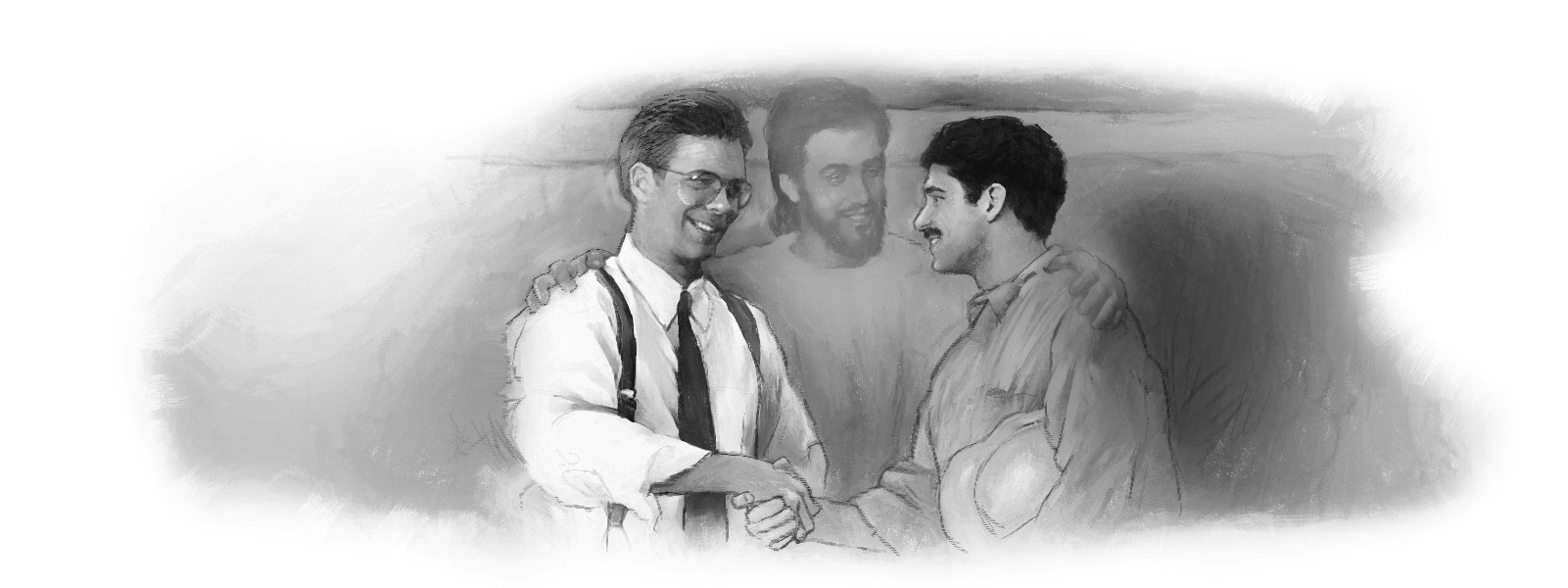
When people live and work in close proximity, they meet a variety of challenges. Differences of opinion may cause tensions; arguments may ensue. The closer the relationship, the more important it is for everyone in that relationship to get along.
The closest relationships are, of course, within the family. The home has sometimes been called "the family firm." It's an interesting way to describe how the home operates. There are definite similarities between running a business and running a household. There should be general agreement on values, goals, and objectives. Everyone should get along with each other and do their part well for things to run smoothly. The same principles apply to the church, which is essentially a large family.
In our passage for this week, Paul provides some vital principles for how a Christian family functions best. Because the Christian home should be governed by biblical principles, it necessarily functions somewhat differently from the typical Roman household. Paul also gives other valuable principles that are helpful for a variety of social relations, both inside and outside the home.
* Study this week's lesson to prepare for Sabbath, March 21.
Husbands and Wives
Several sets of instructions for Christian homes are included in the New Testament (see Eph. 5:21-6:9, Col. 3:18-4:1, Titus 2:1-10, 1 Pet. 2:18-3:7). Notably, these "household codes," as they are called, are not completely hierarchical but include elements to make the relationships more reciprocal and mutually edifying.
Read Colossians 3:18-19. What balance do you see? What additional counsels does Paul give in Ephesians 5:22-25, 33?
Some men quote, "Wives, submit to your husbands" (Col. 3:18, ESV), and stop there, but notice the important qualifier Paul adds: "as is fitting in the Lord." Nowhere does the New Testament teach that women are to submit to all men; nor that wives are subservient or subjugated; nor that they are to blindly submit to their husbands' every whim or desire. Paul's point is that the wife's loyalty is to the Lord first and to her husband second. The wife's individuality must not be swallowed up by her husband, nor can he act as her conscience.
Christ's love for the church in giving Himself up for her illustrates how husbands should love their wives (Eph. 5:25). They will be faithful regardless of the cost. They will make decisions that are in the best interests of the wife, though normally these interests should be aligned. Love like this makes it easier for the wife to obey God's command to respect her husband (Eph. 5:33).
A healthy Christian marriage is characterized by mutuality--consulting each other, thinking things through together, and making decisions as a couple. Sometimes, when making decisions that have serious implications for the whole family, it may be appropriate to include children in these discussions, but never should parents quarrel in front of them. After such a process, if the husband and wife are unable to come to an agreement, the biblical path to peace is for the wife to acquiesce to her husband's judgment, provided it does not violate the Word of God. By the same token, most, if not all, husbands can recall times they were happy that they listened to their wives and took their advice. The more the husband and wife work together as a team, the happier the marriage will be.
How can we avoid doing what has, unfortunately, been done all through history: taking the beautiful principles expressed in these texts and turning them into something evil?
Parents and Children
Children have a vital role as part of the family firm. They need to know they are loved and valued as members of the family and citizens of the heavenly kingdom. Family worship is crucial, simple but regular, morning and evening. At an early age, children can start helping with cleaning and other responsibilities. Most important, they should heed Paul's command: "Obey your parents in all things, for this is well pleasing to the Lord" (Col. 3:20, NKJV).
Read the following passages. What principles are given for raising children?
Prov. 22:6, 15
Matt. 19:14
Deut. 6:6-7
Prov. 1:8-9
Rightly trained for the Lord, by precept and example, children will be a blessing to the family, the church, and beyond. And Paul's instruction for parents, like his instruction for husbands and wives, is balanced and reciprocal: "Fathers, do not provoke your children, lest they become discouraged" (Col. 3:21, NKJV). How parents, particularly the father, interact with and discipline children profoundly impacts their spiritual upbringing.
Studies show, too, that when both parents go to church, a higher percentage of children remain churchgoers, as opposed to if only one parent goes. Even more surprising, consistent church attendance by the father, even more than by the mother, means a greater number of children remain in church as adults. The role of the father, then, in the spiritual formation of his children, cannot be underestimated. How crucial that fathers take their roles seriously.
Not all fathers, however, have been (to put it mildly) exemplary role models for their children. How can knowledge of God as our Father help bring healing where needed, especially when earthly fathers have caused great damage?
Work Relations
Read Colossians 3:22-25 and Colossians 4:1. What instructions are given to slaves? What principles are here for work relations generally?
People today sometimes bring up slavery as a way to relegate some of the Bible's counsels to the past, if not to discredit Scripture entirely. But, ironically, this takes little to no account of the historical contexts within Old Testament Israel and the New Testament church. Human beings are made in God's image and, like all of God's intelligent beings, are designed for freedom. Mosaic laws prohibited Israelites from being perpetual slaves (Deut. 15:12) and stipulated six years as the maximum term of service to pay off financial indebtedness (Exod. 21:2-6, Lev. 25:39-43). The slavery in the Bible, however repugnant to our modern sense, was not normally like the abominable practices of slavery that have been seen in the Western world, which was a scourge and horrific crime against humanity.
In New Testament times, the church had to operate within the framework of Roman law, which provided for owning slaves, "But, unlike modern forms of slavery, Roman law afforded slaves considerable rights and opportunities, and attempting to overturn the practice could have threatened the advancement of the gospel."-- Clinton Wahlen and Wagner Kuhn, "Culture, Hermeneutics, and Scripture: Discerning What Is Universal," in Frank M. Hasel, ed., Biblical Hermeneutics: An Adventist Approach (Silver Spring, MD: Biblical Research Institute/Review and Herald Academic, 2020), p. 166.
In fact, within the church, unlike more generally within the Roman Empire, the slave's first obligation was to the Lord. And their masters were instructed to treat them fairly, "knowing that you also have a Master in heaven" (Col. 4:1, NKJV). Moreover, Paul instructed Philemon not to treat Onesimus any longer as his slave but as his brother (Philem. 16). Actually, in both the Old and New Testaments, believers are called slaves (or servants) of God (see, for example, Ps. 34:22, Luke 17:10, 1 Pet. 2:16).
Even if we don't like the cultural circumstances in which some Bible texts were written, we still must accept the authority of the text itself. Otherwise, we have placed ourselves and our culture above Scripture. The better option is to look at everything the Bible says about a topic before reaching a conclusion about what the Bible is telling us about it.
Consider how this passage could apply to your relationships at work. How might its principles be helpful to you as a boss or an employee?
Praying for One Another
Read Colossians 4:2-4. What principles for prayer do you find in these verses? What prayer requests does Paul make?
Some of the most important words we can say to someone who is struggling with issues of various kinds, be they family, health, money, or something else, are "I'm praying for you." This is heaven's chosen means of connectivity and interactivity. "It is a part of God's plan to grant us, in answer to the prayer of faith, that which He would not bestow did we not thus ask."--Ellen G. White, The Great Controversy, p. 525.
Notice the impactful descriptions of prayer Paul uses: "Continue" (or persevere), "earnestly," "being vigilant," and "with thanksgiving"--signaling that this is a prayer of faith (Col. 4:2, NKJV). He tells us to pray "always" (Eph. 6:18) and "without ceasing" (1 Thess. 5:17). Most amazingly, even though "we know not what we should pray for as we ought . . . the Spirit itself maketh intercession for us with groanings which cannot be uttered" (Rom. 8:26).
Reread Colossians 4:3. What "door for the word" (NKJV) might God open for you to share your faith?
Significantly, Paul also prayed for the right words to speak. Sometimes, when we read his letters or his speeches in the book of Acts, we imagine that the apostle was always eloquent, with never a doubt as to what he should say. But here he asks for prayer that he may proclaim the message "clearly" (Col. 4:4, NIV). He also uses a very important Greek word (dei) in the last phrase of the verse, which could be translated "as I must speak," pointing to the divine necessity of the work of proclaiming the gospel. He recognized the importance of presenting the message to people at the highest levels of the Roman government, including Caesar's household.
"It is not always necessary to bow upon your knees in order to pray. Cultivate the habit of talking with the Saviour when you are alone, when you are walking, and when you are busy with your daily labor. Let the heart be continually uplifted in silent petition for help, for light, for strength, for knowledge. Let every breath be a prayer."--Ellen G. White, The Ministry of Healing, pp. 510, 511.
Walking in Wisdom
What is the most important truth that we, as Christians, can know? Of course, it is that Jesus Christ died for our sins and that, through faith in Him, we can have eternal life. This is a truth that we could have never figured out on our own. Instead, it was a truth that had to be told, or revealed, to us. And it has been revealed to us--in the Word of God.
There's a great deal of truth, knowledge, and wisdom that we would never have known were it not for what God has revealed to us in His Word. But this knowledge and wisdom have not been given to us just as knowledge, just as something to know. Rather, we are to live out in our own lives this truth, this knowledge, and this wisdom.
Read Colossians 4:5-6. In what situations does Paul indicate we especially need to "walk in wisdom"? Why might that be?
Unfortunately, as Christians, sometimes we are anything but Christian! And, as Paul indicated (quoting Isaiah 52:5), Israel was also a stumbling block for unbelievers: "For the name of God is blasphemed among the Gentiles through you" (Rom. 2:24). How we act toward others, especially those not of our faith, matters a lot (see Titus 2:5, 2 Pet. 2:2). A Christian home, a gathering of youth for prayer rather than for mischief, simple kindnesses, and a calm, patient spirit speak volumes to those who are watching to see whether our profession is genuine or not.
In Colossians 4:6, Paul focuses especially on the words we speak: "Let your speech always be gracious" (ESV). More than simply kind or polite, the words we speak should be prompted and permeated by God's grace through the influence of the Holy Spirit.
"Seasoned with salt." Opposite to the world's definition of "salty" speech, our words should be fitting and appealing to those we address.
"That you may know how you ought to answer each one" (NKJV). Only the Holy Spirit can give us the right words at the right time for the right purpose and prepare the minds of the hearers for the message we "must" share (here, too, dei is used--see yesterday's comments on Colossians 4:4).
Think about your words, your actions, and how you walk before others. What message are you sending about your faith and what it means to be a Christian?
Further Thought: "Every member of the family should realize that a responsibility rests upon him individually to do his part in adding to the comfort, order, and regularity of the family. One should not work against another. All should unitedly engage in the good work of encouraging one another; they should exercise gentleness, forbearance, and patience; speak in low, calm tones, shunning confusion; and each doing his utmost to lighten the burdens of the mother. . . .
"Each member of the family should understand just the part he is expected to act in union with the others. All, from the child six years old and upward, should understand that it is required of them to bear their share of life's burdens."--Ellen G. White, The Adventist Home, pp. 179, 180.
"We must let Christ into our hearts and homes if we would walk in the light. Home should be made all that the word implies. It should be a little heaven upon earth, a place where the affections are cultivated instead of being studiously repressed. Our happiness depends upon this cultivation of love, sympathy, and true courtesy to one another. . . . We should be self-forgetful, ever looking out for opportunities, even in little things, to show gratitude for the favors we have received of others, and watching for opportunities to cheer others and lighten and relieve their sorrows and burdens by acts of tender kindness and little deeds of love. These thoughtful courtesies, that, commencing in our families, extend outside the family circle, help make up the sum of life's happiness; and the neglect of these little things makes up the sum of life's bitterness and sorrow."--Ellen G. White, Testimonies for the Church, vol. 3, pp. 539, 540.
Discussion Questions:
- For married couples, what principles have helped you in your relationship? What advice do you have for the unmarried, and how they should prepare for the challenges that marriage always brings?
- Many loving, caring parents who raised their children in fine Christian homes often have to deal with adult children who reject the faith. What advice and comfort can you give them? What might be better not to say at all?
- Discuss further the admonition to "walk in wisdom." In contrast, what does it mean to walk in "stupidity" as opposed to wisdom? What did you learn from the different times you might have walked in one or the other?

Rene Tucaldo
Rene Tucaldo
"Nothing Is by Chance"
Shortly after Rene arrived in the Philippines, he received an offer to work as an accountant with the Adventist Development and Relief Agency. After one and a half years with ADRA, he worked for eight years as an accountant with the Adventist Church's Cavite Mission. Rene enjoyed working with the Adventist Church. Life was simple and comfortable. As a boy, he had thought that becoming an Adventist was a path to wealth. But now he had no desire to be rich. He just wanted to serve others until Jesus' second coming.
One day, Rene unexpectedly received an invitation to replace the retiring treasurer of the 1000 Missionary Movement, which is part of the Adventist Church's Southern Asia-Pacific Division and trains hundreds of missionaries every year at its headquarters in Silang, a city in the Cavite Mission.
Rene wondered if he was dreaming. He had wanted to be part of the 1000 Missionary Movement ever since he had given his heart to Christ through the friendship of one of its missionaries. That missionary, Rodel, now worked as an ordained pastor in the Philippines, and he would be surprised and pleased if Rene became treasurer. But Rene wondered, "Can I handle the job of treasurer? I'm only a simple accountant."
That night, Rene dreamed that he was working at the 1000 Missionary Movement. Then the president of the Southern Asia-Pacific Division asked him to submit his resume for consideration for the job. A short time later, a division committee approved his candidacy, and he was hired.
Rene hasn't looked back. As he has been faithful to God, he has seen relatives who once despised his faith join the Adventist Church. Two months after he moved back to the Philippines, his parents were baptized. "That was God's gift to me," he said. "It was like God was saying, 'Because you have been loyal to me, I have a gift for you.'" His two sisters also were baptized.
Meanwhile, the company where he had worked abroad collapsed during the Covid pandemic. If he had accepted the pay increase, he would have lost everything. Today, he said, he owes all to the Lord who declares, "For I know the plans I have for you, plans to prosper you and not to harm you, plans to give you hope and a future" (Jeremiah 29:11, NIV). "Nothing is by chance," Rene Tucaldo said. "God had a plan for me."
The headquarters of the 1000 Missionary Movement in Silang, Philippines, was constructed with the help of a 1996 Thirteenth Sabbath Offering. Just as that offering is still being felt across the Southern Asia-Pacific Division and beyond through the work of the 1000 Missionary Movement, this quarter's offering can also have a long-lasting impact. Thank you for your generous offering next Sabbath. Watch a short YouTube video with Rene at: bit.ly/Rene-1000MM.
Sabbath School Net is a volunteer ministry independent of the General Conference Sabbath School Department.
For questions and concerns about the Adult Bible Study Guide,
please contact the editor of the Bible Study Guide, Clifford Goldstein
The web version of the Sabbath School lesson is published on
this site by permission of the Office of the Adult Bible Study Guide, General Conference of Seventh-day Adventists.
Website contents copyright 1996-2025 by Sabbath School Net, an independent supporting ministry.
For permission to copy contents of the web version of the Sabbath School lesson, please contact both the Office of the Adult Bible Study Guide and the publisher of this site.
All art in these lessons and on the cover is published on this site by permission of
GoodSalt.com.

We invite you to join a discussion of this lesson each day on the Sabbath School Net Daily
Lessons blog. And on Sabbath mornings, you are warmly invited to join a group discussion of the week's lesson in your local Seventh-day Adventist congregation. If you do not know where to find your nearest Seventh-day Adventist Church, you can check out the
Seventh-day Adventist church locator.
Sabbath School Net is a supporting website not affiliated with nor funded by the Sabbath School Department of the General Conference of Seventh-day Adventists)It is run by volunteers and costs are covered solely by donations from the users of this site as well as the small commissions generated by sales through our links to online stores.

If you are using this site regularly, please pray for God's blessing on our visitors. Please also ask Him to impress you how you can help with the costs of putting this site up every month. We appreciate any gift to support the ongoing publication of Sabbath School Net, and only you and God know how much you can give. Even a small donation every month helps. And larger gifts are much appreciated. (No, you don't need a PayPal account. Just choose the "Continue" link to the left of the PayPal registration. And, yes, it's safe - as safe as your online bank account.)
Sabbath School Net
You can find a sampling of materials available to aid you in your studies at our Sabbath School Net "Store." (We will get a small commission not only from any books you purchase but also from whatever else you purchase at the same time. These commissions help to underwrite a small portion of the cost of publishing this site.)
You can also go directly to the home pages of stores which will pay us a small commission for whatever you choose to buy, without costing you a penny extra: Amazon.com | AbeBooks Store
Sabbath School Net Home page | Directory of Sabbath School Bible Study materials
Looking for an older lesson? You will likely find it in our Lesson Archives
Contact the Sabbath School Net Web Team
Go back to top of page