
Sunday: Anger at God’s Messenger

Daily Lesson for Sunday 8th of November 2026
Moses, God’s chosen leader, knew the joys and pains of guiding a mixed multitude through a wilderness in search of the Promised Land.
Read Numbers 14:4-11. What is happening in these verses? Why are the people upset with Moses and Aaron?
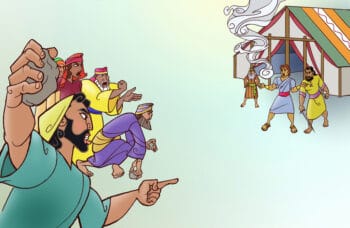
Image © Bible Adventure Collection at Goodsalt.com
A close reading of these verses reveals that the children of Israel were angry at God because they did not trust Him. Moses and Aaron, the human representatives of God’s ultimate Lordship, were easy targets for the nation’s anger. The need for physical and mental safety is a core motivation that all human beings possess. When either is threatened, or we perceive something as a threat to our physical or mental well-being, we can become irate or even irrational.
Read Numbers 13:26-30. Why were the Israelites so afraid? What word of encouragement did Caleb share with them?
The Israelites harbored legitimate fears about the challenges that lay ahead in possessing the Promised Land, “but when men yield their hearts to unbelief they place themselves under the control of Satan, and none can tell to what lengths he will lead them.”—Ellen G. White, Patriarchs and Prophets, p. 389. Moses faced an almost insurmountable leadership challenge in this moment. The fears of the people soon mushroomed into anger against Aaron and Moses and into open rebellion against God. When the people sought new leaders to replace the prophet/leader chosen by God (Deuteronomy 34:10-12, Numbers 14:4), Joshua and Caleb tore their clothes and pleaded with the people to trust in God despite their fears: “ ‘If the Lord delights in us, then He will bring us into this land and give it to us, “a land which flows with milk and honey.” Only do not rebel against the Lord, nor fear the people of the land’ ” (Numbers 14:8-9, NKJV).
|
It’s easy to trust in God when things are going well, isn’t it? How about when disaster strikes? How about when trusting God means discomfort or inconvenience? How well do you do then? |

I would like to write that when our kids were young and naughty, and we told them off, they meekly replied, expressing their sorrow at disappointing us parents, and showed a serious attempt at behaving themselves. The reality was that there were shouts of, “I hate you!” Doors were slammed; sulkiness and general domestic mayhem followed. OK we were not the model Christian family we read about in books, but judging from my observations of other families we were pretty typical. Messages of disapproval and discipline are not well received.
It is perhaps fitting that the Israelites were called the “Children of Israel” because when they received messages of correction, they behaved like children and got angry. No one likes to be told they are wrong. And it takes some time for the message to sink in. The other reaction is to simply ignore the message, and in many respects that is worse than getting angry. Getting angry is a relfex action that may lead to regret and later reformation. “Ignoring” is a more calculated response, telling the sender that their message is unwanted and/or irrelevant.
How do we respond to God’s messages today?
From Moses and the prophets to Jesus and the apostles, God’s faithful servants experienced hostility, rejection, persecution and even death. It must be clearly known that the Christian life is not merely a journey of faith; it is also a spiritual battle. It is a serious reminder to those who choose to obey God, uphold His truth and remain faithful that they should not be surprised when they encounter opposition. In our time, the Bible sounds a clear warning that the Christian life that we have called into is a spiritual battlefield. Jesus Himself raised His voice to warn against this danger. “If the world hates you, remember that it hated me first” (John 15:18, NLT). Jesus further let His disciples be aware that persecution lurks around the corner as they dare become His followers. “If they have persecuted me, they will also persecute you” (John 15:20).
Looking at a closer look at the hostile environment that God’s messengers faced, some notable lessons stand out:
1) God’s appointed messengers will face opposition, surprisingly, not from without but from within. For instance, Moses not only faced hostility from Pharaoh but from the people whom he was called to deliver (Exodus 5:20–21).
2) Those who have been called to labour in God’s vineyard will always encounter a hostile environment. This is not only a physical conflict but also a spiritual one (Ephesians 6:12).
3) Hostility and opposition to God’s messengers strongly show that God’s truth is not easily welcomed. This is a strong warning to us, too. Those who have made a deliberate choice to be followers of Christ must be prepared to face this reality too (Matthew 5:10).
4) How God’s messengers responded to their challenges is a graphic lesson on how we should respond to our own crucibles. How Peter and John responded when they encountered hostility from religious authorities is truly worthy of emulation. “But Peter and John replied, “Do you think God wants us to obey you rather than him? We cannot stop telling about everything we have seen and heard” (Acts 4:19-20, NLT).
5) One of the greatest lessons worth learning from these episodes of hostility and opposition is that we should develop Christian character and not bitterness. Our response to hostility should reveal the character of Jesus.
The greatest test of our faith is not simply how we behave when everything is going well, but whether we remain faithful to God when obedience becomes costly.
𝙋𝙧𝙤𝙜𝙧𝙚𝙨𝙨𝙞𝙤𝙣 𝙤𝙛 𝘼𝙣𝙜𝙚𝙧
The emotion of anger has 5 levels and understanding the levels helps us recognise how a seemingly small emotional disturbance developed into a destructive behaviour among the Israelites. 𝙏𝙝𝙚 first level is 𝙞𝙧𝙧𝙞𝙩𝙖𝙩𝙞𝙤𝙣, a feeling of uneasiness, annoyance or distress caused by an unpleasant disturbance this needs to be managed well if not it develop into resentment. The second level is 𝙄𝙣𝙙𝙞𝙜𝙣𝙖𝙩𝙞𝙤𝙣, which is a reaction to something perceived as unfair, unreasonable or unjust- It is often described as righteous anger or outrage. The third level is 𝙬𝙧𝙖𝙩𝙝, an intense form of anger characterised by hostility and a strong desire to defend oneself or retaliate against a perceived wrong. The fourth level is 𝙛𝙪𝙧𝙮, a state of violent emotional agitation in which a person may lose self-control and act aggressively. The fifth and most dangerous level is 𝙧𝙖𝙜𝙚, an explosive and hostile expression of anger that can lead to extreme acts of violence and brutality. These levels remind us that anger, when left unchecked, can progress from an internal emotional disturbance into outward destructive actions.
The experience of Moses at Meribah illustrates how anger developed when Israelites lost trust in God. 𝙏𝙝𝙚 𝙄𝙨𝙧𝙖𝙚𝙡𝙞𝙩𝙚𝙨 𝙬𝙚𝙧𝙚 𝙖𝙣𝙜𝙧𝙮 𝙖𝙣𝙙 𝙛𝙧𝙪𝙨𝙩𝙧𝙖𝙩𝙚𝙙 𝙗𝙚𝙘𝙖𝙪𝙨𝙚 𝙩𝙝𝙚𝙮 𝙡𝙖𝙘𝙠𝙚𝙙 𝙬𝙖𝙩𝙚𝙧, 𝙖𝙣𝙙 𝙩𝙝𝙚𝙮 𝙙𝙞𝙧𝙚𝙘𝙩𝙚𝙙 𝙩𝙝𝙚𝙞𝙧 𝙘𝙤𝙢𝙥𝙡𝙖𝙞𝙣𝙩𝙨 𝙖𝙜𝙖𝙞𝙣𝙨𝙩 𝙈𝙤𝙨𝙚𝙨, 𝙂𝙤𝙙’𝙨 𝙖𝙥𝙥𝙤𝙞𝙣𝙩𝙚𝙙 𝙢𝙚𝙨𝙨𝙚𝙣𝙜𝙚𝙧 (Numbers 20:2–5). Their hostility towards Moses reflected a deeper problem: their unbelief in God’s ability to provide. Hebrews 3:18–19 explains that they could not enter God’s rest because of their disobedience and unbelief. However, Moses, too, became a victim of the very spirit of frustration he was expected to manage. Instead of following God’s instruction to speak to the rock, he addressed the people harshly, declaring, “Hear now, you rebels!” and struck the rock twice (Numbers 20:8–11). Although the Bible does not explicitly state that Moses was angry, his words and actions reveal frustration and a loss of composure. Psalm 106:32–33 confirms that the people provoked his spirit, and he spoke rashly. His anger was understandable in light of years of complaints, but it was not justified. He allowed the behaviour of the people to influence his obedience to God.
The deepest lesson is that anger against God’s messenger can become a rejection of God’s authority, but God’s messengers must also guard themselves against responding in anger when they are mistreated. Moses was God’s servant, yet he was still accountable for how he represented God before the people. In Numbers 20:12, God explained that Moses had failed to trust Him enough to honour Him as holy before the Israelites. We must not allow the rebellion of others to produce rebellion in our own hearts, nor allow their anger to become our anger. Ephesians 4:26–27 reminds us, “Be ye angry, and sin not: let not the sun go down upon your wrath: Neither give place to the devil.” The challenge for every Christian, particularly those entrusted with leadership, is to recognise irritation before it becomes indignation, wrath, fury or rage. We must learn to respond to provocation with faith, patience and obedience, ensuring that our emotions never cause us to misrepresent the character of God.
Well said. Thank you.
Many thanks for the definitions and clarity regarding stages of anger. I understand better the command to ‘be angry and sin not’
I wonder what was so intrinsically different about Caleb and Joshua in contrast to the ten other men sent out to spy the land of Canaan. Ten men said in so many words- we are not able to conquer that land. Two of them said- we are able.(Numbers 13 and 14)
Please do not misunderstand me. I am not searching for an excuse for their point of view. What I am seeking to understand is how can twelve persons view the same scenery and only two see something different ? And since these two individuals saw something different- “we are well able.” What was so intrinsically different about them that coloured their vision and their point of view.
I know the simple answer; they had faith in God. But their colleagues were not heathens – “All of them were leaders of the Israelites” (Numbers 13:3 NIV ). Even at this stage of my life I am seeking the fulfillment of what I understand to be God-given dreams. In the quest to fulfill these “dreams” I see before me the crying need, the tremendous blessings that would ensue with their fulfillment {the land of Canaan if you please} But Oh the giants ! The Brethren tell me I am not “that young” yet I dream (Joel 2:28)
Maybe my background in Psychology has kicked in. I long to do a Case Study of Caleb and Joshua and compare it with a few of the other Ten who said we are not able to conquer the land. What am I searching for ? What is my quest ? They had faith to say “Yes” to God. How was that faith nurtured ? How was the flames of that faith fanned in comparison to their colleagues who had another point of view.
I seek to take these Sabbath School lessons personally. Today like them I see a Promised Land flowing with milk and honey. Today like them I feel like the two of the Spies that land can be conquered and I hear my Brethren say to me ; Steve, because of your age(at least according to our policy guidelines) you are not able.
I realize that in the last few sentences above I have entered another angle of thought. As I search for answers; could you help me in my quest. A quest I may have to pursue, at least initially ; alone.
Brother Steve – you reached out to ask if we ‘could help you in your quest’. Please allow me to share my thoughts with you. Today’s lesson is about “Anger at God’s Messenger” – how we respond to ‘anger’ directed toward us. May I ask if you compare yourself with those receiving expressions of ‘anger’ from others?
You give me the impression that you believe wholeheartedly that God called you to follow your quest. Do you think you are being held back from engaging in fulfilling your ‘dreams/quest’ by those who consider their fear of ‘giants’ instead seeing the blessings should they supported your quest? That support ‘for fulfilling your ‘dreams’ – entering {the land of Canaan if you please} – harm could come to you and/or others?
I am certain that you have talked with God about the difficulties of finding the right way forward – entering the ‘Promised Land’ by faith – even if you ‘initially go alone’. We are God’s children at any age. I encourage your to continue to emplore God to reveal the purpose He has for you and how best to work in His fields for which He uniquely equipped you. I am confident God will reveal to you His Purpose and Way for which He has and continues to equip you! Jer.29:11; Psalm 37:4.
Thank you Sister Brigitte for your words of guidance and encouragement.
Indeed Moses was leading a caravan of children across the wilderness. However he wasn’t blindly leading them, he was following the leading of the LORD. How many times had the LORD revealed himself to them? Time after time He worked miracles; parting the Red Sea, drowning Pharoah’s army, cloud by day and fire by night, daily manna, water from a rock, bitter water made pure, and more. Yet the people threw a tantrum like toddlers denied in a grocery store.
How Moses didn’t walk off the job is amazing. Most people would’ve thrown up their hands and quit.
Faith is tested under fire and it’s easy to grumble and resist if our faith is not “fireproof.” When the going get rough is exactly when we must lean heavily upon God, not complain and walk away or rebel against the only One who can walk us through the situation. Even today many Christians have a flimsy faith that is firm as long as all is well but waffling when things get tough. If we never forget the promise of God that He will never leave or forsake us even to the end of the world, and we never leave or forsake Him, then we will be able to pass through any difficulty with our faith strengthened instead of fractured.
It’s not about us or our abilities, it never was. It’s all about God’s abilities in our times of necessity, and our availability to God. This is how our faith becomes fireproof.
My faith grows stronger when I face unsolvable situations. When I cannot see a reasonable way out of some challenge is when I have to trust the Lord the most. And although I think sometimes that the answer is what I think, God can show me otherwise! And He never forces me (anyone) to choose His ways.
As a laborer in God’s vineyard it can be vexing to receive persecution, but I am thankful for the all the verses and instruction from the Bible to comfort our souls and give us direction. Joshua was on the receiving end of some horrible persecution, but he knew where to put his focus on, which was strengthening his and his family’s ties to God (Joshua 24:15). When we receive trouble from the outside let’s draw even closer to our loved ones so we can be a haven of love in the midst of this cold world.
Why were the Isrealites so afraid to go into the land flowing with milk and honey? Good question.
Frankly the majority of the spys distractacted them from what God said, I will give you the land. Numbers 13:28, 30. For that mistrust in God they forfeited the Land of Cannan for 40 years. Quarter 3 and 4 of last year reiterated the answer. Also you remember that the Isrealites were not murmuring to Moses and Aaron, God told Moses it was murmuring against Himself.
Q3 Why were the Israelites so afraid? Because they were measuring the situation against the enemy, instead of measuring the situation against God. I have done this so many times. When my eyes are not on Jesus I fear. If I focus on my temptations, they win. If I focus on the Lord, surrender to him, there is nothing but victory.
Q4 What word of encouragement did Caleb share with them? Maybe, let us pray about it and seek the Lord first.
Reflection Question:
It’s easy to trust in God when things are going well, isn’t it? How about when disaster strikes? How about when trusting God means discomfort or inconvenience? How well do you do then?
Joshua and Caleb tore their clothes, pleaded with the crowd. Trust doesn’t always mean calm, doesn’t mean no fear. Jesus sweated blood. Trust is not letting fear make the decision. Same with David before Goliath. David faced the lions and bears before the giant showed. Are we spending time with the Lord like Joshua exodus 33:11, “11 So the Lord spoke to Moses face to face, as a man speaks to his friend. And he would return to the camp, but his servant Joshua the son of Nun, a young man, did not depart from the tabernacle.” He dwelt in his presence. Caleb “fully followed the Lord” Deut 1:36. So they spent time with the Lord. They also went through the same stuff as everyone else, hunger, thirst. And they counted the blessings from the Lord, the manna, the water, the protection. David had the same with the Lions and Bears before Goliath. I pray that I, that we, spend more time with the Lord. That we look for those blessings to build our faith. Crisis doesn’t build trust, it reveals it.