
Sabbath: Paul’s Ministry in Corinth

Daily Lesson for Sabbath 27th of June 2026
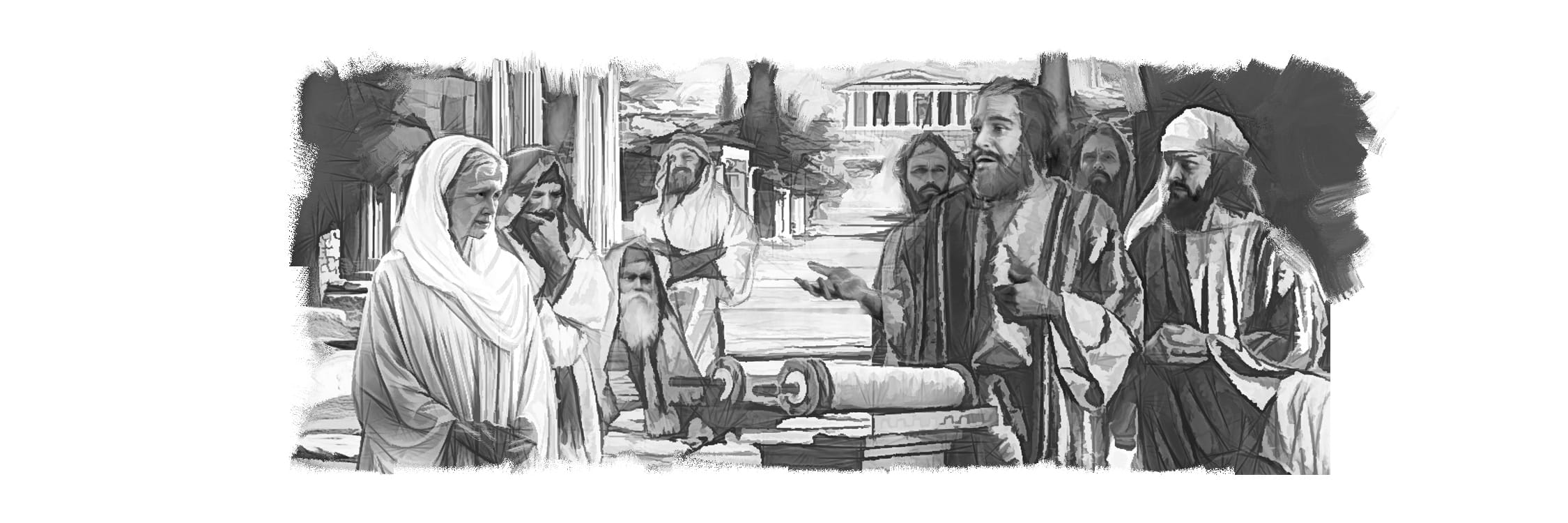
Image © Pacific Press
Read for This Week’s Study
1 Corinthians 1:1, Galatians 1:1, Acts 17:16-34, 1 Corinthians 5:9-11, Acts 18:4-10, 2 Corinthians 2:4.
Memory Text:
“One night the Lord said to Paul in a vision, ‘Do not be afraid, but speak and do not be silent; for I am with you, and no one will lay a hand on you to harm you, for there are many in this city who are my people’ ” (Acts 18:9-10, NRSV).
The great English missionary William Carey used to say that he cobbled shoes to pay his expenses, but his real business was winning souls.
Likewise, Paul worked as a tentmaker for a living (Acts 18:1-3), but his real business was, of course, winning people to Christ.
This week, we will get a glimpse of Paul’s ministry to the church in the city of Corinth. The church, as we will see, was full of problems, many that were not unlike what our churches face today, almost two thousand years later. Indeed, anyone who has been in Christianity for any length of time, or who has been involved in church work, could ask the question: Have you ever found a Christian group that doesn’t have any problems? The answer is, of course, obvious.
Paul faces challenges in Corinth but does so with the message of the Cross (1 Corinthians 2:2). Faithfulness to this message is also the way to face the challenges that we have today. As we will see this week and throughout this quarter, the message of 1 and 2 Corinthians applies to our lives, as well.

Corinth was a major city in New Testament times. It was situated on the Peloponnese peninsula of Greece. That is the bit that is almost cut off from the mainland of Greece by the Corinth Canal. In those days they used to haul small ships across the narrow isthmus on rollers. The city was very cosmopolitan, with not only Greeks but also Romans and a large Jewish population. There was also an itinerant population of travellers, sailors and people with commercial interests.
It is probably not surprising that in such a mixed environment, life was a bit immoral. The ancient Greeks had a slang term, “korinthiazomai,” to mean “to act like a Corinthian”-in other words, to practice immorality.
Just behind the city on the southern side was a mountain bluff, the Acrocorinth, with a temple to Aphrodite (goddess of love) on its summit.
This gives us a brief outline of the environment where Paul worked and built a Christian Church. It helps us understand some of the challenges he writes about in his epistles. While I was researching the Corinthian background, it struck me that our environment today is not all that different. Paul’s Corinthian epistles are potentially very relevant to us.
Paul reminded the believers in Corinth that the message of Christ crucified was offensive to human reasoning, writing, “For Jews request a sign, and Greeks seek after wisdom; but we preach Christ crucified, to the Jews a stumbling block and to the Greeks foolishness” (1 Corinthians 1:22–23, NKJV). Yet God chose the cross—the very symbol of shame, suffering, and apparent defeat—to reveal His saving power, for “the foolishness of God is wiser than men, and the weakness of God is stronger than men” (1 Corinthians 1:25, NKJV). While the cross was the greatest demonstration of God’s love and power to redeem humanity, the message of the cross remains the only way lost humankind can be reconciled to God, for “the message of the cross is foolishness to those who are perishing, but to us who are being saved it is the power of God” (1 Corinthians 1:18, NKJV).
I wonder whether sometimes we miss the essential “message of the cross”? It is not only that Christ lowered Himself to the depth of suffering as depraved humanity in the most humiliating manner by being crucified on a cross. And it is not only that, in so doing, he bought our salvation.
But Christ demonstrated the principle of heaven by being dead to self and practicing self-renouncing love. I just read this week in Testimones to the Church, Vol III, that this self-renouncing love and spirit of service is the very essence of heaven’s bliss. The message of the cross includes this: We can experience heaven’s bliss only by dying to self and living to serve. As that death to self occurs, we can experience the joy of heaven now.
Conversely, if we do not die to self and live to serve here, we would not be comfortable in heaven, and God won’t take us there.
It is not a comfortable message.
(We’re reading the Kindle version because we find it most convenient.)
Something we should know is that during the time of the Apostle Paul (around AD 51), Corinth was a bustling, affluent Roman colony and the capital of the Roman province of Achaia. Situated on a strategic isthmus, its two vibrant ports made it a wealthy, diverse, and morally complex crossroads of the ancient world.
Yet Paul was commissioned to serve Corinth and other Gentile (pagan) regions throughout the vast Roman Empire.
Hold that thought…
That fact alone should be a catalyst for our mission. God wants them all—not only those already within the church. God’s mission crosses every boundary; it is never limited.
What a beautiful way to begin this quarter—with this powerful text. Read it again:
(Acts 18:9–10)
Paul’s books have featured more frequently in the Adult Sabbath School Bible Study Guides in the last five years.
1. 2022 Q1 (Jan–Mar) – In These Last Days: The Message of Hebrews
2. 2023 Q3 (Jul–Sep) – Ephesians
3. 2026 Q1 (Jan–Mar) – Uniting Heaven and Earth: Christ in Philippians and Colossians
4. 2026 Q3 (Jul–Sep) – First and Second Corinthians
This frequency is not by accident or a deliberate bias towards Pauline studies. I seem to see a deliberate orientation towards two critical aspects:
1) Salvation
2) Christian identity.
In all that we do as believers, we need to remind ourselves more urgently that our salvation draws ever closer than when we believed. In a world which is saturated with all sorts of beliefs, our identity as Christians is a matter which has eternal consequences. The time has come to make our calling and election sure.
“So, dear brothers and sisters, work hard to prove that you really are among those God has called and chosen. Do these things, and you will never fall away.” (2 Peter 1:10, NLT)
Let us be deliberate not only as Christians but as a remnant people who arose out of the Millerite movement, uniquely Seventh Day Adventist. May we be purposeful and deliberate in our witness, not ashamed of the 2300 year prophecy, the message of the sanctuary, the 3 Angels message and Christ’s soon return.
I am speaking this way from Freeport Maine because we just finished the 2026 NNEC Campmeeting with Ivor Myers. The theme was “His Way is in the Sanctuary”. We even had a full size sanctuary replica courtesy of “Messiah’s Mansion” which sat beside the road for all to see on the campus of Pine Tree Academy.
Ivor Myers spoke 9 times in an enthusiastic and Spirit filled journey throughout the Old and New Testament. He stressed we as SDA people need to be, and must be “on fire” to defend our unique message for a dying world. Of course Christ and Him cricified is the center of every chapter in the Bible.
I had the opportunity to drive the bus on two Adventist Heritage tours through Portland, Gorham and Brunswick Maine for the campmeeting.
Anyhow, I have been re-energized and have “heartburn” as Ivor Myers repeatedly emphasized.!!! May we be Spirit filled as we go forward as “fishers of men” this quarter.
Esther Pelletier was there also and I pray she ways in with her unique perspective.
Looking forward to studying the word of God this quarter.
I pray that the Holy Spirit will guide and direct our understanding and help us apply the knowledge to our lives.
Paul wrote these two books with over 10 chapters, each. Letters to the Corinthians were because there problems he needed to address. We will cover the lessons we get and maybe applicable to us. Maybe some maybe prompted to step into the water and go a little deeper. I did last quarter. John 3:5.
Our Christian life and witness matter.
What am I doing to win souls for Christ? Am I so busy with my work that I forget what I should really be working for? Does this have to be intentional? Or does the way I live tell more about Who I work for than my own labor?