
Sunday: Elijah—Praying in Crisis

Daily Lesson for Sunday 10th of May 2026
Faithful Elijah lived in evil times, with King Ahab doing more “to provoke the Lord God of Israel to anger than all the kings of Israel who were before him” (1 Kings 16:33, NKJV). By far the most dramatic moments in Elijah’s life came with the confrontation at Mount Carmel (see 1 Kings 18:1-46). At the climax of this incredible story, Ahab and his kingdom saw with their own eyes the truth that God answers prayer. This was an unforgettable moment in Israel’s history and is why the sudden change of events in this story catches us by surprise.
Read 1 Kings 19:1-18, specifically noting Elijah’s prayers and God’s interaction with him. What is at the heart of Elijah’s dejection here? How is God’s response different from what happened at Mount Carmel?
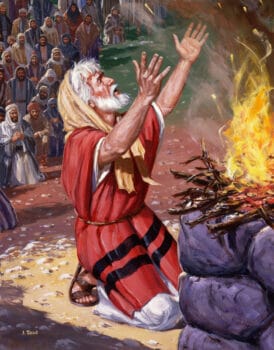
Image © Providence Collection at Goodsalt.com
Throughout the course of one day, although God answered every one of Elijah’s prayers, the prophet’s emotional, mental, and physical state soon shifted. Although Elijah had experienced a great victory with God that day, he had, in a moment of weariness, allowed the fear of death to overcome his faith in God. What is so striking about this story is that, although Elijah gave in to despondency and discouragement, God came to him in tenderness and care, providing food and water again (1 Kings 19:5-6)—so much so that he lasted for 40 days and 40 nights (1 Kings 19:8). And when God finally revealed Himself, it was in a very different manner than He had before.
Sometimes in our lives, God answers in very direct, powerful, and undeniable ways. This strengthens our faith, and we feel the closeness of God in our lives.
Other times we waver and give in to temptation, thinking that it’s too hard to follow God with unswerving faith. We look for God’s answers in ways we expect Him to respond, not realizing that His thoughts and ways are far higher and wiser than our own (Isaiah 55:8-9). Just as there is much about God’s creation that we don’t understand, we shouldn’t be surprised that there is much about God’s ways that we don’t understand either.
|
God, our good and kind Father, knows exactly what you need. How can you be still enough to trust Him and keep your eyes steadfast on Him through it all? Talk to Him about this now. |

My second prayer is for being a witness in our community.
Just beautiful.
Like the Chinese bamboo tree that remains beneath the ground for over 5 years before suddenly shooting and rising to 90 feet within 3 months, ministry often requires long seasons of unseen faithfulness. For months or even years, it may seem as though nothing is happening despite continual effort and prayer. Yet growth is still taking place beneath the surface. “Let us not grow weary while doing good, for in due season we shall reap if we do not lose heart” (Galatians 6:9). God calls His servants to keep sowing, trusting, praying, and enduring even when visible results are absent. The harvest comes in His timing, not ours.
Elijah experienced this struggle after his great victory on Mount Carmel. God had answered his prayer with fire from heaven, proving that Yahweh alone is the true God, leading the people to worship Him and bringing judgment upon the prophets of Baal (1 Kings 18:36–39). Yet immediately afterward, Elijah fell into discouragement and despair when Jezebel threatened his life. His expectations seemed shattered, and he focused more on people and circumstances than on God’s power and presence. When we fix our eyes on human actions, whether through admiration, disappointment, or resentment, we can lose sight of what God is doing. “We walk by faith, not by sight” (2 Corinthians 5:7). Like Elijah, we must remember that God is still at work even when present conditions seem hopeless.
God holds us responsible not for results, but for faithfulness. On the mountain and in the valley, Elijah was called to trust, obey, endure, and continue the work God had given him to do. In the same way, ministry requires perseverance, love, and steadfast faith. We cannot change hearts or control circumstances; only God can do that. “So then neither he who plants is anything, nor he who waters, but God who gives the increase” (1 Corinthians 3:7). Mountain-top victories are often followed by valleys, and our greatest defense in those moments is prayer and unwavering trust in the Lord.
It’s astonishing to see that Elijah who has shown full trust in God is the same who is now doubting the power of God in just a few moments after. This is true in our lives too but we thank God who is constantly waiting for us. He asked Elijah, what are you doing here? We can’t fall so deep that the Lord can’t look for us from there and He can’t forgive us. He is still looking for us for greater work in the gospel that is lying ahead of us.
“O Lord, take away my life” ( 1 Kings 19:4), Elijah prayed a short while after a great spiritual victory at Mount Carmel. Great spiritual victories do not make believers immune to human weakness. Elijah wanted to die after running away from Jezebel (1 Kings 19:2-3). God listened compassionately but did not answer Elijah literally. God did not kill Elijah. However, God restored him. This reveals one fundamental truth about prayer: not every sincere prayer we pray is the will of God.
One important aspect of practical prayer is to tell God how you feel about something. Over the years, I have learned to tell God my feelings even when I know they are not right. There are times when I feel like not forgiving because I have been too hurt. I tell God how I am feeling. There are occasions when I am too upset by someone and develop some bad feelings. I tell God how I am feeling about the person. I thank God He always has a way to restore my wounded spirit. We should emotionally surrender to God, and He will strengthen our broken spirits.
God did not rebuke Elijah but listened compassionately and gave him sleep, food, rest and gently restored him. This is truly remarkable how God deals with our human shortcomings. God sees when we are emotionally exhausted. Let us openly pour our emotional exhaustion to Him, and He will give us rest and restore us physically, spiritually and emotionally. Our prayers need to be transparent. There is nothing we can hide from. He knows the depths of our hearts.
“Cast all your anxiety on him because he cares for you.”</b< (1 Peter 5:7)
Am always blessed by your profound remarks on the lesson brother Omwenga.
Thanks brother 🤝, I have learnt a lot in your writing 🫂. Be blessed 🙏
This very dramatic day of Elijah’s life, I see parallels for myself. Elijah was pouring out every ounce of himself for God: (1) he appeared before a king who had placed a personal death threat upon him to deliver God’s message, (2) on the mountain he called down fire from heaven in prayer in the name of God, (3) he slew 450 prophets of Baal with his own hand, (4) he prayed earnestly for the nation and God answered with rain, (5) he ran in the slippery pouring rain the whole way back to Jezreel ahead of the king’s chariot. Elijah had put his whole mind, body, emotions, time, passion, commitment, identity, future….everything….on the line for God.
My connection #1: I feel called of God to be constantly drawing closer to Him through digesting His Word and through prayer. And further, I feel called to lead God’s people in sharing His Word together. Just as in Ahab’s day, these end-of-world times are very wicked and these lessons we are learning last week and this week on prayer are very timely and precious. Using the gift of teaching as God wants me to is my priority. Every minute possible of every day last week, I put time into preparing to lead the group’s study. I wrote pages and pages of notes each day on things that spoke to me, reviewing and highlighting key areas on Friday. I wrote prayers for each day of the lesson last week…I prayed about it in the night when I would wake up. I prayed earnestly that God would speak through me and through others what He wanted to say. That He would help me to facilitate a Spirit-filled, meaningful time together.
Back to Elijah – After pouring himself out for God, when he arrived at the palace he received a short note from the Queen, “By tomorrow at this time, I’m going to kill you in revenge for killing my prophets.” How did Elijah respond?
This one threatening note from a pagan queen undid the man who had just faced down 450 prophets without flinching. He felt an instant depression and sadness. He fled to be by himself. He felt weary of working so hard for God with so much opposition in response. He prayed that he might die, and said, “It is enough. Now, Lord, take my life, for I am no better than my fathers.” He felt like he had nothing left, like it was time to tap out and go home.
My Connection #2: Our study began in a room full of people eager to read the Bible together. And so many needs represented around the table. There is the dear older saint who wants to do all the Bible reading. There are those who want to do the leading and steering the discussion. There are those who have not yet had a chance to talk. I’m trying to balance insights given to me with time for others to speak with moving the lesson along to hit all of the main points. And then there was a moment when I said, “Let’s move on to the next day’s lesson,” and someone replied that they felt like I was talking down to them, like I was a schoolteacher and they were but kids. I apologized and the person said, “No worries.” But I felt my inner disappointment, like I failed God. And on my ride home, I said, “God, I tried so so so hard to provide a meaningful discussion forum to lift up You, Your Word, and prayer. No matter how hard I work at it, I feel like I don’t get it right. All of the roles You give me, I fall down. And lots of times when I fall down roles are taken from me.” And I told God other things like that. See, it doesn’t just feel like a singular experience….I think that was true for Elijah too….the queen’s note was the straw that broke the camel’s back….the camel who had been working for God so so hard.
Takeaways for Elijah and for me:
Elijah: I don’t think it was just the fear of death that led to his depression. There are clues to me that Elijah had let himself and his own ego get between God and God’s people. Up on the mountain, he started to swagger?
(1) We see him taunting the false prophets, “Maybe your god is meditating, or he is busy, or he is on a journey, or sleeping and must be awakened. Cry louder” (1 Kings 18:27). This is sarcasm – and no sarcasm, I believe, is from God. It denotes a certain sense of superiority. I get it, Elijah was frustrated by the idolatry, but to me this is a similar moment when Moses said, “Must WE strike this rock for water for you.” Elijah is confusing what his role is and what God’s role is. God never taunts; Satan is the accuser.
(2) Another clue is when Elijah told God, “I have been very zealous for the Lord God… and I alone am left as a faithful prophet” (1 Kings 19:10,14). See the focus on his own actions and on his own importance for God’s work? God gently replied, “No Elijah, there are actually 7,000 faithful left” (1 Kings 19:18).
Me: I believe God is gently telling ME that I’m placing too great an importance on my role. Yes, digest the Bible all day every day and take notes, and pray all day every day….but on the mountaintop….in that moment when God’s people are gathered….take a back seat. It’s not MY words but GOD’S WORDS that are to be heard. The relationship God and I have speaks the loudest for Him.
And my urgency to see God’s people in His Word more, in prayer more, this feeling that I need to urge everyone on lest we sleep as time grows short….well, I’m not the only one left with this thirst for God, this urgency for us as a people. God has His remnant. I need to listen more than I speak if I’m losing sight of God and getting sassy, hurt by comments, etc. True love for God has no place for pride. Sometimes He asks us to toss His mantle of responsibility to others (1 Kings 19:16, 19).
The crisis was external for Elijah, but it was also internal. Same for me and for all of us. The Great Controversy is being played out on every stage of home, work, government, church….but most importantly it is being played out in our own minds. If I can rest in “It is no longer I who live but Christ who lives in me” (Gal. 2:20), then I won’t burn out in service for Him, with Him.
Thank you for sharing, Esther. The Holy Spirit spoke to me as I read it.
I am grateful that the Bible reveals the experiences of human beings that struggle, just like me. How is it possible that after such an amazing manifestation of God’s power on Mount Carmel, Elijah would be trembling in fear because Jezebel made a threat against him? It isn’t just at Mt. Carmel, the climax of this amazing story, that God showed up for Elijah. Through direction from God, Elijah declared a drought that lasted 3 years, then at God’s appointed time, prayed for rain to return. He raised a widow’s son from the dead. In the three years of drought, God miraculously provided for Elijah. Given all of that, Jezebel makes a threat and Elijah falls apart. Really?!
But in Elijah I see myself. Like Elijah, I find that sometimes mountain-top experiences are followed by valleys of despair, testing, or monotony. I sometimes hold onto expectations of how things should go, and when things don’t go the way I anticipated, I get anxious. I have often asked myself, like the Psalmist “Why, my soul, are you downcast? Why so disturbed within me?” My head reminds me how faithful God has been. How he’s brought me through time and time again. But my heart is unsettled. Really?!
My favourite name for God is El Roi. The God who sees me. I love that he gets me. When my reactions don’t make sense, he gets me. When my prayers are more like complaints or are short sighted, he gets me. And he comes to me tenderly and patiently. He provides strength for the day and whispers in his still small voice. He holds me in his loving embrace and doesn’t let me go when I don’t make sense.
Practical prayer is being open with my thoughts and feelings before this God. Acknowledging to Abba my mess ups. Letting Him hold me when I don’t feel right, think right, or act right. Not running away and waiting to come back when my thoughts and feelings are more sanctified. Trusting that there is nowhere I can run from his presence, and that in his presence there is fullness of joy.
It might seem ironic that the man who could call fire from the sky—thrice; the hairy man wearing a leather belt around his waist; the man who walked and was energized by God Himself—could cower, hidden and terrified, from the words of a lesser being like Jezebel. The one through whom all could witness the blessings and power that God had given him was now broken, weary, and petrified of a monarch whose prophets and gods he had, through God’s power, just moments ago obliterated. Why?
And how does God react? He feeds him and gives him rest. God sees through His prophet—Elijah is weary, he is exhausted. God sees this and is patient with him, and though God has (1 Kings 19:18), He understands Elijah and still gives him more work to do, but also answers his prayer by relieving the heavy load, distributing it to Hazael, Jehu, and Elisha. Hmm! Another answered prayer.
Maybe this says more about how God approaches our weariness by providing a support structure. We might think Elijah was “overestimating himself,” but not at all—God understood his frustration. He understands us too. He doesn’t judge us, but gives us a chance to propel forward. He restores our momentum by answering our prayers in the way that can give us the velocity necessary to do His marvelous works.
like Elijah’s get answers that relate to the time, the place, and the witness. God is answering our prayers, even now, in the best way that He knows for us. I just get so excited knowing this.
In order for us to be refined Christians God allows us to go through the mental, physical and spiritual fire/test. Just like the process of getting pure gold. Just as God allows us to accomplish a victory right after a test comes. (Elijah situation) We cannot afford to lose heart we must trust in God and not lean on our own understanding in good times and bad times. (Proverbs 3:5,6)
Hello All. I follow this page daily. Thanks for all your insights I want to share this lesson for today in song using the Key Word “Victory” from Hit the Mark Sabbath School https://m.youtube.com/watch?index=1&ra=m&list=PLkA5TmeiWbW8muEuFklIYwWCrsJo4MFhS&fbclid=IwRlRTSARtWnxleHRuA2FlbQIxMQBzcnRjBmFwcF9pZAo2NjI4NTY4Mzc5AAEeWKpDD0k-oCpQSfL2F5LMtCxqkcspeiH7DA7jN_vrP6KSDKE4b-tSqcpkwAw_aem_K7Eu13h4o3vtb1cn6jvZ0A&pp=iAQB8AUB&v=bBijtAxWRHE
Oh God,in times when I am overwhelmed with discouragement and my belief in you is shaking, please help my unbelief.
Amen!
I actually think the issue for Elijah was less fear and more despondency. Initially he probably did run out of fear of Jezebel, but by the time he reached the wilderness he was asking God to let him die (ironic). And his words “I am no better than my ancestors” suggest he really expected a revival in response to the showdown at Mt. Carmel and was devastated when it didn’t happen. Further comments show he was focused too much on himself and not God’s oversight of the situation. I think we can be the same way. But God was patient and gentle with Him as He is with us.
What a Lesson, please read what’s in the link today. Perhaps you may feel there is no time, but I’m 100% sure you will find a treasure in those words! We all need to learn about the secret of happiness, and prayer is the key to talking with the Giver of it.
Sometimes God will answer by fire like on mount camel, but other times, he will answer in a still small voice. we should not limit God to specific terms and conditions