
Thursday: A Message for Laodicea

Daily Lesson for Thursday 26th of March 2026
Read Colossians 4:16-18; compare Colossians 2:1-3. Thinking about Jesus’ message to Laodicea (see yesterday’s study), what correlations do you find with that of Colossians, which was to be read also in the Laodicean church of Paul’s day?
Looking at the history of God’s people through the ages, the same problems occur again and again. The prophets rebuked Israel for wanting to worship like the world and urged them to repent before it was too late. Isaiah even lamented, “How the faithful city has become a harlot!” (Isaiah 1:21, NKJV) and urged the people to return to God for forgiveness and cleansing (Isaiah 1:16-20).
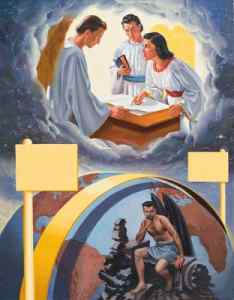
Image © Review & Herald Publishing from GoodSalt.com
Both John the Baptist (Matthew 3:2,8-10) and Jesus (Matthew 4:17, Matthew 12:33-37) called upon the Israelites to repent and bear fruit that would stand the test of the judgment in the last days. The apostles bore a similar message (Acts 2:38; Acts 3:19; Acts 17:30; 2 Corinthians 7:9-10).
Compare the following passages: _Isaiah 60:1-3 with Revelation 18:1-4, and Isaiah 62:1-5 with Revelation 19:7-8_. What similarities exist between the messages in the two books?
God will unite heaven and earth. But because of the great controversy, that must be done in stages:
-
At Calvary, Satan lost any affection left toward him among the heavenly beings (John 12:31).
-
Through the judgment ministry of Christ in the heavenly sanctuary, God’s people are “complete in every good work to do His will” (Hebrews 13:21, NKJV) and fitted for heaven.
-
Through the millennial judgment and the final judgment after the millennium, all remaining questions are forever settled, and sin and unrepentant sinners are destroyed in the lake of eternal fire, which also cleanses the earth (Revelation 21:8).
-
Only with the end of sin can heaven and earth finally be united (Revelation 21:3).
|
What can you yourself (not looking at anyone else) do in order to remain faithful to God and to the truth He has given us? That is, what choices are you making that reveal who truly has your heart? |

The epistle to the Colossians in essentially about the supremacy and sufficiency of Jesus. Interestingly, the lesson author quotes from Isaiah in today’s lesson. We understand that the book of Isaiah is a messianic prophecy and in chapter 60 it describes the result of living in a relationship with the Messiah:
But we should also read how Isaiah describes Israel’s present state. In Chapter 1, God describes his distaste for religiosity without compassion. In between these bookends, Isaiah described the work of the Messiah, not has an arrogant king but as a sacrificial lamb. The human state is contrasted with the character of the Messiah and when we fully understand the Messianic message, we can be a light to the rest of the world.
The Colossian epistle was written against a background of the temptation of the beginnings of Gnosticism. The idea that salvation was bound up in special spiritual knowledge. Paul emphasises that Christ is sufficient and that consequently we are to show love and compassion to one another. Pauls pastoral letter is not one of condemnation but one of compassion and encouragement.
There is a message in all of this for modern Seventh-day Adventists. We are not to place our faith in our religiosity, our own identity, or our special knowledge. We need to look to Jesus and direct others to him. And one of the best ways to do this is to show humility and compassion towards others.
Maurice – thank you for your comment and including Isaiah 60:1-3. May I comment on your statement: “The human state is contrasted with the character of the Messiah and when we fully understand the Messianic message, we can be a light to the rest of the world.”
I needed to Google ‘Messianic message’ because I did not fully understand what it meant, finding the following definition: “In essence, the Messianic Message is a promise of divine intervention to bring an end to evil, suffering, and sin, restoring the world to a state of peace and knowledge of God.” Emphasising ‘divine intervention’ being at the heart of this message.
I understand this to mean that God’s Glory is at work. He offers us to be born-again, receiving a changed ‘character’. You contrast the human ‘state’ with the character of the Messiah, which expresses the Glory of God. Quoting Isaiah 60:2 – but the LORD shall arise upon thee, and His Glory shall be seen upon thee…”
In this light, do we not need to be careful how we ‘understand/interpret’ ‘character’, since we are saved by Grace through faith? It is God’s Glory that shines its Light into the heart of the born-again believer, leading him out of spiritual darkness into heaven’s Light – transforming, enabling and leading the believer to ‘engage in acts designed before the world began’ – that they should walk in them. Man cannot add anything ‘good’ in order to change his character. All that is ‘good’ about man is the evidence that God’s Glory has found a home in man’s heart and mind – Eph. 2:10.
Paul’s letter to the Laodicean Church is not preserved in the Bible. Paul simply mentions that he had written a letter to them (Colossians 4:16). At the same time, he does not state what was the message in the letter. However, the message must have been important because Paul’s writing was always inspired by the Holy Spirit. Secondly, it must have been important for Paul to recommend it to be read by the Colossians as well. Nevertheless, the Book of Revelation gives us a clear picture of the spiritual condition of this church (Revelation 3:14–22). From this Bible passage we are informed that this church had some spiritual issues; lukewarmness, pride and self-reliance, materialism, complacency, spiritually blind and naked.
Jesus’s rebuke to the Laodicean Church is actually our rebuke. Their spiritual condition mirrors our present-day condition. The Laodicean message is our warning. While Jesus is still uniting heaven and the earth, may we repent our sins and accept the salvation which is found in Christ Jesus. Despite of this condition we are in, there is hope, Jesus says.
“I correct and discipline everyone I love. So be diligent and turn from your indifference. “Look! I stand at the door and knock. If you hear my voice and open the door, I will come in, and we will share a meal together as friends.” (Revelation 3:19-20, NLT).
The church in Laodicea suffered from a spiritual disease that Christ diagnosed as lukewarmness or nominal religion without the transforming power of His presence. Though the church maintained an outward form of devotion, it lacked genuine faith and the life changing power of Christ. The believers were attentive to external observances, yet they denied the inner power that produced true spiritual vitality. The root cause of Laodicea’s lukewarmness was closely associated with its wealth, prosperity, and material success, which led to spiritual complacency and self-sufficiency.
Feeling rich and secure, the church in Laodecia failed to recognize their deep spiritual poverty and need for Christ. The message Christ gave them is that their condition was not only disappointing but nauseating to Jesus, who warned them, “Because you are lukewarm—neither hot nor cold I am about to spit you out of my mouth” (Revelation 3:16). This message stands as a stern reminder that true wealth, splendor, and spiritual vision are found only in Christ, and we must guard against complacency by seeking a vibrant and transforming relationship with Him.
The message to Laodicea is a sobering one. Could the cause be that yesterday’s lesson wasn’t learned? What I mean is, when we are loving the things of the world, we have lost sight of the Giver of all good things, and begin to worship those things instead of the giver of them. This can easily lead to a “meh” response to God. No wonder it makes Jesus sick to his stomach after all he did to save us, and we go awhoring after other gods, which aren’t gods at all.
Just thinking out loud.
The best choice we can make is to seek to do God’s will in everything. The development of a loving relationship with the Father passes by the cross of the Son.
Leodacea is a topic we should not skirt, sidestep if you prefer. Paul is addressing the Laodecea church also in his fourth chapter to the Colossians, it is a condition non of us want to be in.
The way to be hot is a daily relationship with God.
And to trust in the Lord with all our heart. “Let him that thinketh he standeth, take heed lest he fall.” 1 Corinthians 10:12. Our only safety is in constant distrust of self, and dependence on Christ(sure salvation).” Christ Object Lessons 155.2. This keeps us from self reliance. My confidence of salvation does not rely on me rather my confidence rely on putting myself in Christ, with Christ and through Christ I can say He is mine and I am His as witnessed by the Holy Spirit. Romans 8:16. Then as Paul admonished rejoice in the Lord always and again I say rejoice, Philippians 4:4. Then we are hot not lukewarm, and God will not have to spit us out. Revelation 3:16.
Now if you are like me and drink ginger-lemmon-honey tea you will wait for it to cool a bit, till it is hot, not scalding, so as to avoid burnt tongue. No intended point, other than a healthful tea.
I think we have to be a little careful between connecting Laodicea as mentioned in Revelation to Laodicea as mentioned in Colossians. There were at least 30 and probably closer to 40 years between the writing of the two books. Has your church changed in 30 years? Mine certainly has. I’m not saying there aren’t connections with the message in Colossians, but we have to be careful about trying to make things fit to prove what we want.
Laodecea church represent the lukewarm class in the church of God in the history of the church[Apostolic to the second coming of Christ]
Characteristics of this class inside the church of God according to Revelation 3:14-18
[14]“And to the angel of the church of the Laodiceans write, ‘These things says the Amen, the Faithful and True Witness, the Beginning of the creation of God:
[15]“I know your works, that you are neither cold nor hot. I could wish you were cold or hot.
[16]So then, because you are lukewarm, and neither cold nor hot, I will vomit you out of My mouth.
[17]Because you say, ‘I am rich, have become wealthy, and have need of nothing’—and do not know that you are wretched, miserable, poor, blind, and naked—
[18]I counsel you to buy from Me gold refined in the fire, that you may be rich; and white garments, that you may be clothed, that the shame of your nakedness may not be revealed; and anoint your eyes with eye salve, that you may see.
Thank you for writing, Jane, but I think you may have missed Christina’s point. She is writing because she knows the meaning of the message in Revelation.
She is suggesting that we should be cautious about the Laodicea mentioned in Revelation with the Laodicea which Paul referenced in his letter to the Colossians because “There were at least 30 and probably closer to 40 years between the writing of the two books.” A church can change a lot in 30 – 40 years.
I think Christina’s caution is valid for the reason she cited and more.
All we really know is that the message Paul sent to Colossae was to be read in Laodicea also.
You have a valid point I did not think of. Yes it is possible that the Laodicean church had Christ and sup with Him before John wrote Revelation 3:15-16. Let us pray that we as part of our church open the door to Christ to come in and allow Him to sup(fellowship) with us. For we have need of Him. Rev. 3.20.
My guess is that if the Laodicean church was lukewarm for 30 years, it might not even have made the list of John’s churches.
Of course, some problems persist in churches for a long time. But Jesus had a message for the Ephesians too in Revelation and it seems quite different from Paul’s epistle. We just have to be careful about making assumptions.
May the grace of God that surpasses all understanding strengthen me in my walk with God.
Since the lesson make a side trip into Laodicea, I’d like to share an idea that a pastor and theologian friend of mine shared with me many years ago. It concerns the imagery in verse 20. To begin, who is the letter written to? It is written to the “church at Laodicea”. A body of believers, symbolized by a building they worship in (which may have actually been a house then). So when Christ is standing, knocking at the door, what is that door? Well, it’s the door of the church at Laodicea. The interesting thing is that the door is shut. He’s outside. He’s knocking. This is His church! But no one appears to hear. No one is listening. No one is coming to the door. What are they doing inside? He seems to be talking, too. Maybe yelling to be heard above the commotion inside. So he says, “if anyone hears me, if anyone opens the door, if anyone cares, I will come in. Will you invite me into your church (um I mean My church)? If you do, I will come in and share a meal (socialize) with you”. Ironically there will be others inside that church who won’t share in that communion. They won’t even know he came in.