
Monday: Paul in Chains

Daily Lesson for Monday 29th of December 2025
While in Macedonia, Paul mentions multiple imprisonments (2 Corinthians 6:5, 2 Corinthians 11:23, 2 Corinthians 7:5). The first recorded instance was in Philippi (Acts 16:16-24). Later he was imprisoned in Jerusalem briefly before being transferred to prison in Caesarea.
Elsewhere, Paul mentions being “in my chains” (Philemon 1:10,13, NKJV). Although under house arrest in Rome, he was chained to an elite Roman soldier. Ignatius, a Christian of the early second century who was chained up like this, described the soldiers as behaving like “wild beasts . . . who only get worse when they are well treated.”—Michael W. Holmes, ed., The Apostolic Fathers (Grand Rapids, MI: Baker Academic, 2007), p. 231.
Read 2 Corinthians 4:7-12. In this passage, what reveals how Paul was able to endure the trials he faced? What seems to be the focus of his life?
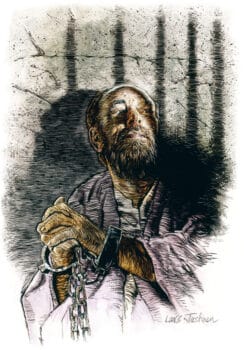
Image © Lars Justinen at Goodsalt.com
No matter how hard life got, Paul was able to see a brighter side, and that gave him courage to bear up under stress. Despite Satan hurling everything he could, Paul knew he was not forsaken.
Read 2 Corinthians 6:3-7. What spiritual resources did Paul have available to help him face these difficulties?
Often, we may be tempted to look at our circumstances, our weaknesses, or our past failures and become discouraged. It’s at times like these that we need to remember all the amazing provisions God has made for our success in battling evil. One of the most important is the Bible itself, “the word of truth,” because we can learn from others’ mistakes and also learn how these people have succeeded. Also, the Holy Spirit “makes effectual what has been wrought out by the world’s Redeemer. It is by the Spirit that the heart is made pure. Through the Spirit the believer becomes a partaker of the divine nature. Christ has given His Spirit as a divine power to overcome all hereditary and cultivated tendencies to evil, and to impress His own character upon His church.”—Ellen G. White, The Desire of Ages, p. 671.
|
How can we, as laity or as clergy, always “commend ourselves as ministers of God” (2 Corinthians 6:4, NKJV)? What does that mean? |

In my youth my thirst for reading led me to H V Morton’s book, “In the Steps of Saint Paul”, Even then it was an old book, written in 1936, it opened a window of understanding for the writings of Paul. It made the places real – they either still exist today, or their ruins are there for us to study. So, when I read his epistles, I had a picture in my mind of where these people live and the things that were important to them. I had a quick look through the lesson pamphlet, and it gets down to the theological business pretty quickly. However, I want to take the time to say something about Phillipi and Colossae in the hope we will better understand these epistles. Paul visited Phillipi butnot Colossae. They are very different towns In this comment I will provide a description of Phillipi and tomorrow I will to a similar coverage of Colossae.
Phillipi was a very Roman town in what is now northern Greece (Macedonia). There was a big battle there in 42BC and it was settled by retired Roman soldiers who brought with them the Latin language and Roman culture. The main religion was the Imperial Cult – mainly a set of rituals honouring Ceasar. We need to understand that this was more a loyalty thing than a religion in the modern sense.
The Jewish presence in Phillipi was small. They did not have a synagogue (You need a quorum of 10 men for that). Instead, the women met for prayers by a stream outside the city gates. Lydia is mentioned in this setting. She was a seller of purple, a dye made from the murex shellfish. Interestingly she wasn’t a local, She had come from Thyatira, which was about 450km east in Turkiye. Reading between the lines I think Lydia was a very rich business woman. Tyrian purple was reserved for royalty because It was so expensive
Paul and Silas were put in prison essentially for disturbing the status quo – the veneration of Caesar. We all know the story of how they were released by an earthquake. Interestingly, Paul make use of his Roman citizenship in the aftermath pointing out that they were entitled by law to better treatment than what they received.
The ruins of Phillipi are extensive and show ancient Greek walls, a theatre, a forum, and a gymnasium; all the things you would expect in a very Roman ancient city.
Hopefully you find this background useful. Tomorrow I will continue with a similar description of Colossae.
Happy Anniversary Mr & Mrs Ashton. May God’s richest blessings continue to be showered on you.
Thank you, Erma. Maurice and Carmel
All human beings are in some kind of chain, externally inflicted or self-inflicted. Paul was in chains imposed on him by Roman authority (external chain). On the other hand, the Bible identifies another type of chain, which is self-inflicted. This arises from our own choices. We exercise our free will, but unfortunately, we end up in chains. Misuse of freedom ends up in captivity. Bad choices lead to bondage. “Very truly I tell you, everyone who sins is a slave to sin.” Sin normally begins as a voluntary act but ends up in bondage. Sin is a choice which drags its victims into shackles.“The evil deeds of the wicked ensnare them; the cords of their sins hold them fast.” (Proverbs 5:22).
As we find ourselves in our diverse chains, let us always remember that God want to set us free. In fact, the prime objective of Jesus’ coming to the planet is to set us free. “He has sent me to bind up the broken-hearted, to proclaim freedom for the captives and release from darkness for the prisoners.” (Isaiah 61:1). Only Jesus has the power to release and restore us from the scars inflicted upon us by the chains of the devil. “So if the Son sets you free, you will be free indeed.” (John 8:36). There is no chain which is too strong that Jesus cannot break.
“Come to me, all you who are weary and burdened, and I will give you rest. Take my yoke upon you and learn from me, for I am gentle and humble in heart, and you will find rest for your souls. 30 For my yoke is easy and my burden is light.” (Matthew 11:28-30, NIV).
Amen. Yes indeed there’s not chain that is stronger than the power of Christ. If we want to be released from the chains that bound us , let’s ask God. As Matt 7:7 says Ask and we will receive, seek and ye shall find , knock and the door will be open to you.
That’s the exact position Paul, the man previously known as Saul found himself in. Saul had to be blinded by the light to see the reality, but in blind darkness his spiritual and mental eyes were open yet he could see clearly from this point. A natural response for any of us existing today in such a situation, is to sink into depression, disappointment and despair and feel betrayed. However, for Paul seeing failure was not the option but he allowed God to transform this fall into propulsion (better still into “propagation”) to service for God. Using the same zeal he had launched himself with against “the truth, the way and the light”, he morphed his disappointment by accepting a new divine appointment.
While the above statement sounds delightfully poetic, reading 2 Corinthians 6:3-7 tells us the whole frame of mind of Paul which is not a very pleasant (verse 4-5) but verse 6-7 he reveals how to change these many disappointments into blessings by armouring ourselves in “the character of God” ( 2 Peter 3:9; Exodus 34:6; Psalm 86:15; Galatians 5:22).
“Paul in Chains” is Far from defeat, his chains symbolized not restriction but a commitment to Christ and a platform to God’s work with purpose towards advancing the Gospel, mental and spiritual freedom, encourage the other sojourners, and appreciating a new perspective in life.
“Outside were conflicts, inside were fears”. But Paul moved on because his focus was on Jesus Christ, his Master!
“Christ has given His Spirit as a divine power to overcome all hereditary and cultivated tendencies to evil, and to impress His own character upon His church”.
The answer to endurance in our struggles is in the Holy Spirit! How much then should we pray to receive Him!
Matthew 5:16 says “Let your light shine before men that they may see our good works and glorify your father who is in heaven”. For me, the best way to commend ourselves to God is to practice the will of God. This means trusting and honoring God’ sacrifice for my sins, acting kindly and justly to people, and recognizing my need of forgiveness of sins from God as well as my need to forgive those who have wronged me.
Speaking of Paul’s attitude towards his life, I love how the NLT expresses this passage.
“And now I am bound by the Spirit to go to Jerusalem. I don’t know what awaits me, except that the Holy Spirit tells me in city after city that jail and suffering lie ahead. But my life is worth nothing to me unless I use it for finishing the work assigned me by the Lord Jesus—the work of telling others the Good News about the wonderful grace of God.” Acts of the Apostles 20:22-24 NLT
A clergyman/woman could set standards based on the LORD’s commandment to live a good life for others to adapt. It would be improper for the clergy to be impatient, knowing that a temperamental person might not be rational in his/her reason to be right. If we are meant to be ministers of God, then it would be our solemn duty to set a good example for others to adapt (Philippians 3:17).
Ellen G. White – ‘The Desire of Ages’ –
“Trough the Spirit the believer becomes a partaker of the divine nature. Christ has given His Spirit as a divine power to overcome all hereditary and cultivated tendencies to evil, and to impress His own character upon His church.”
Do we still need anyone else’s narratives or interpretations explaining how to live the Christian’s life in sincerity and truth?
2 Cor.6:3-10 – ”We put no obstacle in anyone’s way, so that no fault may be found with our ministry, but as servants of God we commend ourselves in every way by great endurance:
in afflictions, hardships, calamities, beatings, imprisonments, riots, labors, sleepless nights hunger;
by purity, knowledge, patience, kindness, the Holy Spirit, genuine love; by truthful speech, and the power of God;
with the weapons of righteousness for the right hand and for the left; through honor and dishonor, through slander and praise.
We are treated as imposters, and yet are true; as unknown, and jet well know; as dying, and behold, we live; as punished, and yet not killed; as sorrowful, and yet always rejoicing; as poor, yet making many right; as having nothing, yet possessing everything.”
Brigitte, you ask the question:
My response is this:
When I used to teach Chemistry we had a book, “Advanced Inorganic Chemistry” by Cotton and Wilkinson, as our text book. At the time it was regarded as the best book on the topic. (I still own it). But in our classes I always encouraged my students to tell me in their own words what they thought were the key issues in the topic under discussion. I did not want recitations from Cotton and Wilkinson. I wanted to hear what they thought in their own words. Why do you think I did that?
And I raise the issue that our discussions here in this forum are more useful when we talk to one another about what we believe and think is important, rather than just quoting Bible texts and Ellen White paragraphs to one another. When we express ourselves and listen to one another we often get a better understanding of the ideas and at the same time better understand one another. Quotes can be useful but as discussion springboards rather than approved answers.
Maurice; “The warfare against self is the greatest battle that was ever fought.” STC
I contemplate these inspired words daily as I submit to God in my daily battles with self.
Ellen White(of the last paragraph)has good advice for us during trials whether it be in prison or by maliciousness to friend or loved one the same God who saw us born again will carry us through. He does expect us to prepare for trials of our faith. How do we prepare for trials. Study the Bible. For us Seventh-day Adventist study the Spirit of Prophecy, making it the lesser light to the Bible. If settling a controversy use the Bible. Have a time for devotion daily. To get even closer to God, with respect, treat Christ as friend and a brother. Welcome the Holy Spirit, after all He is a witness of our spirit, whether or not we are genuinely sons and daughters of God. Romans 8:16.
I, Paul, write this greeting with my own hand. Remember my chains. (Colossians 4:18)
Did Paul’s shackles clank as he penned this postscript? His letter to the Colossians lifts us to the heavens with soaring sentences portraying the beauty and power of Jesus and his magnificent gospel:
“He is the image of the invisible God.” (Colossians 1:15)
“By him all things were created.” (Colossians 1:16)
“He is the beginning.” (Colossians 1:18)
“He is the head of the body, the church.” (Colossians 1:18)
“This mystery . . . is Christ in you, the hope of glory.” (Colossians 1:27)
“Christ . . . is your life.” (Colossians 3:4)
At the end of this letter, though, Paul brings us back down to earth, reminding his readers that he was in chains. This is not a prayer request so much as more gospel truth the iron-hard reality that the advance of the gospel will meet with opposition. Persecution does not stop its progress; rather, it is part of it. That’s been clear from the beginning.