
Sunday: You Were There!

Daily Lesson for Sunday 21st of December 2025
“Then Joshua gathered all the tribes of Israel to Shechem and called for the elders of Israel, for their heads, for their judges, and for their officers; and they presented themselves before God” (Joshua 24:1, NKJV).
Shechem was the place where Abraham had built an altar upon his arrival in the land and where God first gave him the promise of the land (Genesis 12:6-7). Now, when the promises given to Abraham have been fulfilled,
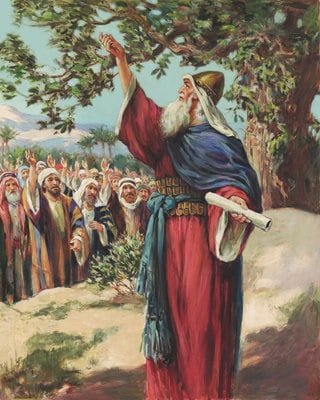
Image © Provident Collection Goodsalt.com
Israel renews the covenant with God at the very place where the first promise had been given. The appeal of Joshua recalls the words of Jacob to “ ‘put away the foreign gods which are among you’ ” (Joshua 24:23, NKJV; compare with Genesis 35:2-4). The geography of the event in and of itself conveys the call to demonstrate undivided loyalty to the Lord, rejecting all other “gods.”
Read Joshua 24:2-13. What is the main thrust of God’s message to Israel?
God is the main subject of the reviewed past: “I took,” “I gave,” “I sent,” “I plagued,” “I did,” “I brought you out,” “I delivered you,” and so on. Israel is not the main protagonist of the narrative but rather its object. It is God who created Israel. Had not God intervened in the life of Abraham, they would have been serving the same idols. Israel’s existence as a nation is not the merit of any of its ancestors but the exclusive work of God’s grace. The fact that the Israelites are settled in the land is not a ground for boasting but the very reason why they should serve God.
The Lord’s speech contains a shift that occurs five times between “you” and “they” (the fathers). The fathers and this generation at Shechem are treated as one. Joshua is seeking to show what Moses affirmed already in Deuteronomy 5:3, that the Lord did not make the covenant only with the fathers but with all those present at the moment of Joshua’s speech. The vast majority there now had not experienced the Exodus. Not “all” of them were at Horeb. Yet, Joshua says that all of them were there. In short, the lessons of the past must be appropriated by each new generation. The God who worked for the ancestors in the past is ready to act on behalf of the present generation.
|
What are ways in which we can, as a church, have a better sense of corporate responsibility—that is, grasp the idea that what we do impacts everyone in the church? |

I have not been to a camp meeting for quite a while, mainly because I had my fill of them when I was a conference employee and we had to attend from start to finish and often on duty from dawn to midnight. But, I still remember the big meetings where the large tent was filled with several thousand people, singing, “We Have this Hope”, and listening to an important American speaker calling on us to be faithful to the end. It was actually quite thrilling and usually at the end of the main service there would be an altar call for those who wanted to rededicate their lives to the Lord. At moments like those, you thought that with God’s help you could move the world.
Then it was back to work, for us teachers, the very next day. We faced the same kids who rebelled by not doing their homework, drinking cans of Coke with their lunch, and all the other ordinary things that Seventh-day Adventist kids get up to. For the ministers, it was going back to little country churches where the farmers ate meat, and paid tithe only in good years.
My point is, the intentions of a big rally often get spread thin by the tyranny of distance and time. Joshua and the Children of Israel had the same problem. And if you want to see how thin the “big meeting” promises were, turn the page and read the first few chapters of Judges. It take more than a big meeting to build a faith community. I am not saying we should not have them, but if we want our faith community to be effective we need to think how to sustain it rather than just how to kick start it.
We had 100mm of rain the other day, so we planted some plants to take advantage of it. Now, a week later, our temperatures are going over 40C (104F) every day. To keep our plants alive, we water them every day with a hose.
Big meetings inspire but they do not build lasting
character.”Another generation grew up who did not know the Lord or what he had done for Israel.” Judges 2:10.
After the excitement fades, life resumes:Teachers face the same classroom struggles.Pastors return to small congregations with everyday realities.Believers confront ordinary temptations and frustrations.
Israel faced the same issue after Joshua’s death.Without ongoing instruction and accountability , commitments made in great assemblies weakened over time.
Just as plants survived the heat only through daily watering, faith survives life’s pressures only through continuous spiritual care.Faith must be sustained, not merely started.
Maurice – may I comment on your “point” that ‘the intentions of a big rally often get spread thin by the tyranny of distance and time,’ as well as the observation that ‘it takes more than a big meeting to build a faith community?’
I am curious: does your ‘point’ address the problems seen from the Seventh Day Adventist community’s perspective’s strict adherence to creed, rules and regulations, or do you also include the problems the world-wide Christian community, the Ecclesia, encounters?
You used a metaphor for exposing a real problem facing all Christians. What, in your opinion, would prevent this ‘evaporation of zeal’ from happening? Who or what waters us? In your perception, what constitutes the ‘antitype’ in your example; that which can ‘water us’ every day as you did the plants when needing refreshing? What keeps our faith and dedication alive after the ‘big rain’?
I meant both. For many of us, our congregations is the bit of the Ecclesia we see most of the time. That is where we have our human relationships and provides the horizon for much of our spiritual experience. It is where we have the opportunity to show love one towards another.
If we are going to be effective, we need to listen to the Holy Spirit, but that often comes quietly in the interactions we have with one another. If we do not listen to them we may not hear the Holy Spirit. I always remember that God once spoke to Baalam through a donkey to get his attention. If God can use a donkey to get a message across, surely he can use our fellow congregation members. They don’e even compare with donkeys. We need to listen more, and spend less time trying to correct doctine and purifying lifestyle. Don’t get me wrong. I think church theology is important, but we live interconnected with others and we need to value those relationships because they are part of our connectedness to God.
The unfinished/incomplete conquest serves as a poignant reminder of the importance of obedience to God’s commands and the dangers of compromise with the surrounding culture. It underscores the necessity of faithfulness to God’s covenant and the consequences of failing to fully trust and obey His directives.
“For as by one man’s disobedience many were made sinners, so also by one Man’s obedience many will be made righteous” (Romans 5:19, NKJV).
The Bible says that all mankind died in Adam without personally eating the forbidden fruit. Also, all mankind lives in Christ without dying on the cross. Likewise, all the Children were at Mount Sinai without physically being there. God’s relationship with His people transcends time and mere individuals; it is grounded in corporate identity, and it is always living in the present. God’s covenant with Israel was not individualistic but corporate. “The LORD made not this covenant with our fathers, but with us, even us, who are all of us here alive this day.” (Deut. 5:3). This implies that we cannot treat God’s Word as a relic that belongs to the past. It is not about other people, nor is it a problem inherited without consent. But God addresses us today; it is our present obligation. He wants us to have a personal relationship with Him today. “Now these things happened to them as examples, and were written for our admonition” (1 Cor. 10:11).
Christian life has a collective responsibility. Christian faith should not be lived in isolation. We, as believers, are called to live, grow, serve and witness together as one body mutually responsible for one another’s spiritual, moral, and practical well-being.
God calls believers to live, grow, serve, and witness together as one body, mutually responsible for one another’s spiritual, moral, and practical well-being.“For just as the body is one and has many members… so it is with Christ.”
(1 Corinthians 12:12). We are a community of believers who share responsibilities and obligations. We cannot grow into the likeness of our Jesus Christ in isolation.“Let us consider how we may spur one another on toward love and good deeds, not giving up meeting together.”. If we can do this, then the whole world will know that we belong to our Lord Jesus Christ.
“By this everyone will know that you are my disciples, if you love one another.”(John 13:34–35). Because we are a community, Jesus gave us the great commission of going and making disciples for Him. “Go therefore and make disciples of all nations.” (Matthew 28:19). In essence, we have a collective identity and collective responsibility. “We were there” (Deuteronomy 5:3), Moses was simply telling the Children of Israel, and us included, that obedience or disobedience is never just personal; it affects everyone.
Some people experience things nobody knows about except God, inner hurts, inner pain, and even some are from scars of love. The million dollar question is what has kept us going despite all the challenges? The odds have been clearly against us. How is it possible that we have endured great stress, how is it that we have been able to handle such serious problems of extreme nature, how it is that we have been under so much extreme pressure and such great stress, and we havent taken leave from our senses? With such great and tremendous distress and we have not yet left the faith. Had the Lord not been there then Israel would have not been successful. The presence of the Lord meant everything to the Israelites and that should be the same for us.
In Joshua 24, God speaks through Joshua and reminds the people of His remarkable works on Israel’s behalf. He begins from their origins as a people to remind them that they who were not a people were made a people through the covenant with Abraham. They are reminded how they were transformed from being idol worshipers to becoming His chosen people with a new identity.
God reminds them of his faithfulness in the escape from Egypt and in the wilderness. The narrative moves from history to their present reality by pointing out God’s faithfulness in the land of Canaan. “I have given you a land for which you did not labour…vineyards and olive groves which you did not plant.” The blessings they received were not merited but were because of God’s favour. In this review of Israel’s history, no mention was made of Israel’s rebellion and failure. Instead, the focus is on God and his faithfulness.
Oh, that I would remember always who I was before God called me into a loving relationship with him and gave me the identify of a daughter of the Most High God. Oh, that I would forever declare the praises of him who called me out of darkness into his wonderful light (Peter 2:9-10). I have obtained favour for which I did not labour. Rather than focus on my weaknesses and failures, I pray that God’s spirit will encourage me today to focus on his faithfulness that he who began a good work in me will bring it to completion. So, I choose again today to serve the God who chose me and proven his faithfulness to me time and time again. So help me God.
The lesson today reminds us that our personal faithfulness and choices are never just private—they directly affect the strength, witness, and future of our entire spiritual community.
We should recognize that, like the Israelites at Shechem, the church today is connected to its spiritual ancestors. Decisions and actions are not just individual but shape the collective identity and spiritual health of the entire body.
May we live each day with this in mind as we sojourn together toward Heaven and home!!!
To me, witnessing, individually or collectively, is a miracle of God. As humans, we are naturally far from the original image God created in us; the only way we can reflect it is through Jesus and the work of the Holy Spirit. By logic, the individual (me) miracle has to happen before the collective (us, church). However, God can make collectivity to influence individuality.
Joshua 24 reminds us that faith is not just history—it is responsibility. God’s message is clear: Israel exists because God acted. Every “I took,” “I gave,” and “I delivered” shows that their survival and success were not earned but received by grace. Therefore, their life in the land was not a reason to boast, but a call to faithful service.
This speaks directly to us as a church today. Faith is often treated as personal, but Joshua shows it is also corporate. People who never experienced the Exodus are addressed as if they did, because in God’s covenant community, no one lives in isolation. What one generation—or one member—does affects the whole body.
To grow in corporate responsibility, we must first recognize that our personal choices shape the spiritual health of the church. Compromise weakens the body; faithfulness strengthens it. Second, we need loving accountability, where we care enough to walk together, not just worship side by side. Third, we should keep telling the story of God’s faithfulness among us, so we see ourselves as one people, not disconnected individuals.
Joshua’s call to choose whom to serve is personal, but never private. In God’s covenant, my faithfulness—or lack of it—touches everyone.
As a church, we should set clear policies based on God’s commandment to groom our spirit in one faith, to overcome discourteous behaviors that tend to undermine other individuals’ values in the church. There is nothing more painful than to feel uncomfortable in church, especially if a member appears to be defective in spirit and needs comfort to deal with the challenge. If someone becomes a reproach to others, the church should show compassion to uplift the individual’s spirit, because a troubled heart is a sick soul, and without love to console the weak in spirit, the person might go astray. If the church fails to show compassion to one of its own, the church will pay a price at the end (Matthew 25:45, 1 Timothy 5:8).
We share Christ because of the goodness of the Lord in our lives. Please lets share our testimonies to strengthen our faith and win others for the kingdom of God.
Thanks for this post