
Tuesday: Free to Serve

Daily Lesson for Tuesday 23rd of December 2025
As a true and faithful leader, Joshua respects the free will of his people and wishes that Israel would serve the Lord out of free choice rather than compulsion. That was exactly the point made by the deliberate use of the verb “chosen” (see Joshua 24:22). In other passages baḥar, “to choose,” describes Yahweh’s election of Israel (Deuteronomy 7:6-7; Deuteronomy 10:15; Deuteronomy 14:2). Israel is free to say “no” to Yahweh after their divine election, but that would be nonsensical and absurd. Israel can say “yes” to God and continue to live, or they can turn their backs on Him and cease to exist.
What was Israel’s response to Joshua’s appeal (Joshua 24:16-18)? Why do you think Joshua reacted to their answer in the way he did (Joshua 24:19-21)?
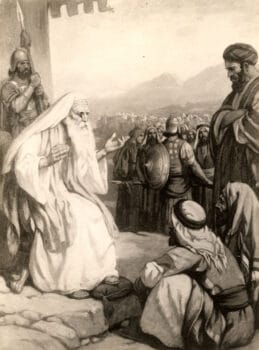
Image © Providence Collection at Goodsalt.com
In their categorically positive answer, the Israelites recognize that the God of the patriarchs and of their fathers is now also “our God” (Joshua 24:17-18, NKJV), whom they are willing to serve with undivided allegiance. After such an unquestionable affirmation of their loyalty, we would expect words of affirmation and encouragement from Joshua. However, this is not the case. The dialogue between Joshua and the people takes a radical turn in which Joshua seems to play the role of the devil’s advocate. He shifts from speaking about God’s gracious providence in the past to threatening the Israelites with a picture of a God who is not easy to serve.
Joshua knows the instability of the first generation, who promised to obey God in similar terms (Exodus 19:8, Exodus 24:3, Deuteronomy 5:27) yet who forgot their promises while the words were still on their lips (Exodus 32:1-35). Thus, Joshua, by means of rhetoric, wants to make the Israelites aware of several things. First, the decision to serve God is a serious one. It will have to shape the entire nation according to God’s revelation. The blessings of pursuing that goal are evident, but the consequences of disobedience must also be fully understood. Forgiveness of sins is not an unalienable right of humanity but a miracle of God’s grace.
Second, the decision of the Israelites to serve God must be their own decision, not something imposed by a leader, even Joshua.
Third, Israel must realize that humans cannot serve God in their own strength. Serving God is not achieved by a mechanical adherence to the stipulations of the covenant but by a personal relationship with the saving Lord (compare with Exodus 20:1-2; Deuteronomy 5:6-7).

What does it mean to serve God freely?
“Whatever you do, do it heartily, as to the Lord and not to men.” (Colossians 3:23)
One of the most practical ways of serving God is to serve Him through our fellow human beings. Jesus made service to our fellow human beings a measure of true discipleship. For Jesus Himself came to serve and not to be served (Matthew 20:28). He said, “Whoever wants to become great among you must be your servant.” (Mark 10:43). Jesus served His Father faithfully. He accomplished the critical assignment He was assigned by His Father here on earth.
On a practical level, serving others is serving God. This may take different forms:
a) Showing compassion to others
b) Forgiving those who do evil to us and not holding grudges
c) Helping those who are in need
d) Treating people with kindness and dignity
d) Loving our enemies
e) Doing justice to all
“No one has ever seen God; but if we love one another, God lives in us and his love is made complete in us” (1 John 4:12)
About 25 years ago I decided to lash out and buy a really good camera that would last me the rest of my life. So I bought a Nikon F100. It was a quality camera and took great photographs. Now, 5 cameras later …! The big change of course was that within 5 years of that purchase, digital technology replaced film and more recently mirrorless cameras have replaced SLRs. And on top of that I have simply worn a couple of cameras out. I have realised that my decision to buy one camera for the rest of my life was pretty short-sighted. It has taken me a while to learn that cameras come and go, but the important thing is that my photographic skill should continue to improve irrespective of the technology.
In this final chapter of Joshua we read of the Israelites making some big decisions that were supposed to last forever. We know they didn’t. The book of Judges tells in graphic detail how far they got away from their promises. It is not easy to read.
We like the drama of Joshua 24:
I reckon most of us can quote that one. The issue is that it is not a one-stop-fix. The big moment decision is only the beginning. We have to develop a dynamic that survives long after the big decision.
As I said yesterday, the garden needs watering!
Biblically,serving God is a personal,voluntary and grace-centered commitment. It cannot be imposed by leaders, achieved through human strength or reduced to rule-keeping. Joshua’s message reminds both Israel and believers today that true obedience grows out of a living relationship with the God who saves first and then calls His people to faithful service.
Scripture consistently shows that God’s people struggle not with making commitments, but with keeping them. Israel’s failure was not in choosing the Lord, but in failing to cultivate a living, ongoing relationship with Him.
Biblical faith is meant to be dynamic,lived out daily in changing circumstances. Just as photographic skill must grow regardless of camera technology,faith must mature regardless of seasons,leadership changes or cultural shifts.
Saying the right words,even sincerely,does not guarantee spiritual endurance.Judges shows that without intentional transmission of faith, piritual decline is almost inevitable.The tragedy of Judges is not that Israel made the wrong decision,but that they failed to keep watering the garden.
Excellent point. Since building a relationship with God is the key, how do we build that relationship?
Biblically,building a relationship with God is not a one-time event,but a lifelong journey.It grows through faith , prayer, Scripture,
obedience and love. As we draw near to God, He draws near to us (James 4:8).
Thanks Douglas.
The bible also says that only those who hunger and thirst after righteousness will get it, Matt 5:6.
In Romans 12:1,2 Paul begs (beseech) us to give ourselves over to the Holy Spirit so that he can transform (change) our nature from carnal to spiritual. We cannot do it by ourselves.
Thanks again and God bless.
Life is made up of a series of choices, and as a result, we are constantly required to make decisions. Some choices carry far-reaching consequences, while others have less impact. The choices we make shape our character, determine our direction, influence our destiny, and even affect our eternity. This reality means that we must learn how to choose what truly matters.
Understanding this truth, Joshua challenged the Israelites to make a clear decision about whom they would serve. He declared, “Choose for yourselves this day whom you will serve… but as for me and my house, we will serve the Lord” (Joshua 24:15). The choice was not whether they would serve, but which God/god they would serve. Joshua was convinced that every person serves something—whether knowledge, wealth, influential personalities, or even graven images and idols.
The power of choice is a sacred gift given by God, and it must be exercised with wisdom and discernment. Serving God must be a wholehearted decision, not one made out of pressure or convenience. While intellectual arguments often follow our choices rather than determine them, the wisest use of our freedom is to submit our decisions to God, trusting that His wisdom surpasses our own. As Scripture reminds us, “Trust in the Lord with all your heart and lean not on your own understanding” (Proverbs 3:5).
Today’s study reveals an incredible truth: serving God is a thrilling journey that involves three powerful steps: responsibility, choice, and relationship! Imagine developing a deep connection with the Creator, discovering just how vast and unconditional His love for us truly is. As we grow in this relationship, our choices will resonate deeper within our hearts. This is exactly what God desires from us! When we truly get to know God, we can’t help but serve Him, inspired by His marvelous love. Isn’t that amazing? God is absolutely incredible!
Shalom Saints, help me understand subjective statements by the Sabbath School lesson staff such as:
(standard) – He shifts from speaking about God’s gracious providence in the past to threatening the Israelites with a picture of a God who is not easy to serve.
(easy read) – Now Joshua gives the Israelites a warning: God is not always easy to serve.
(scripture) -Joshua 24:19 [NIV] 19 Joshua said to the people, “You are not able to serve the Lord. He is a holy God; he is a jealous God. He will not forgive your rebellion and your sins.
I’m not seeing where degree levels (easy, medium, hard) of serving God is stated. I am seeing that the power to serve God is not capable, possible on their/our own.
We can claim the advice Jesus gave us: Matthew 16:24 (ESV) 24 Then Jesus told his disciples, “If anyone would come after me, let him deny himself and take up his cross and follow me. Also, Matthew 11:28-30 (NIV) 28 “Come to me, all you who are weary and burdened, and I will give you rest. 29 Take my yoke upon you and learn from me, for I am gentle and humble in heart, and you will find rest for your souls. 30 For my yoke is easy and my burden is light.”
I’m seeing Joshua like a tv drill sergeant, playful banter – “You Can’t Handle The Truth!”. Subliminal/unspoken challenge – “Prove Me Wrong”. This is my perspective understanding not a concrete, definite statement.
Joshua’s response speaks powerfully to Christians today. Many believers sincerely say “I will serve the Lord,” yet live that promise under pressure from work, culture, fear, or convenience. Commitments made in church, during prayer, or in crisis are often tested in ordinary life—at work, in family decisions, and in moments where compromise feels easier than obedience.
Joshua’s warning is an act of love. He reminds us that God is holy and cannot be served casually or by habit. Faith is not sustained by good intentions or trying harder, but by a real, daily relationship with God. His words invite today’s Christian to pause and ask: Is my yes to God thoughtful, personal, and lived out—or just spoken?
The freedom to choose service is integral to understanding the nature of God’s relationship with humanity. God, in His sovereignty, grants individuals the freedom to choose whom they will serve. This freedom is not absolute autonomy but is exercised within the framework of God’s divine will and purpose.
The concept of free will is essential in this context, as it allows for genuine love and service. Without the freedom to choose, service would be mere compulsion, devoid of the relational depth that God desires with His creation. The biblical narrative consistently affirms that God values voluntary service, as it reflects a heart aligned with His purposes.
Choose service is a profound reminder of the dignity and responsibility bestowed upon humanity. It invites believers to participate in God’s redemptive work, exercising their freedom to serve with joy and purpose.
I believe our natural inability to keep commitments came as part of the package we received by eating the fruit from the wrong tree. Since our word is not good enough, we have contracts to hold us accountable to keep our commitments. Since commitments are so unreliable, many young people choose to have relationships without getting married. Many people are led to believe that by not making commitments they can escape responsibility. I believe this is one of Satan‘s popular deceptions in our current culture. Satan uses our inability to keep commitments to keep us away from God when this is the very condition that should drive us to God in our great need.
After Joshua asks the Israelites to choose between the Lord and the lesser gods of their fathers, if it seems evil for them to serve the Lord, they respond to Joshua that may God forbid that we should forsake the Lord to serve other gods (Joshua 24:16). But knowing for sure that they might turn against God again, Joshua told the Israelites that they cannot serve the Lord because He is holy and a jealous God, and He will not forgive their transgression if they sin against Him (Joshua 24:19).
Joshua knew how God would react if they turned against Him because the previous generation promised to serve God but yet turned against Him. Because Joshua believed that the people may sin against God again, he made a covenant to bear witness to the decision to obey the Lord their God (Joshua 24:25).
‘In Sincerity and Truth’ – does this not cause us to take time to deeply reflect on how sincere we are in believing all that we have learned about our God; how much of that we apply to our every day life; how much we have changed for the better because of it?
I often think that we in the developed, industrialized, more or less stable countries, do not really appreciate the presence of the Christian’s God in our life – we take Him and prosperity too much for granted. On the other hand, those who suffer greatly because of strife causing instability try harder to find the Christian’s God in times of plenty and in time of want.
I ask: ‘Do we truly appreciate, deep down in the secret chambers of our heart, the God who we confess with our lips’? What could the individual find and address when contemplating their sincerity and truth regarding their spiritual walk with God? I consider this effort to be a deeply private matter between the believer and God until His Light reveals the truth, ready to be shared with others.
Ought we not to make sure to present to God by faith the most ‘fertile soil’? There is the parable of the Sower casting seeds on four types of ground: a path, rocky soil, thorny ground, and good soil. Is our ‘ground/soil’ ready to receive the seeds cast by the Sower? How much seed can sprout to take root and continue to grow as it is sustained by the watering of the Holy Spirit? Matt.13:1-23; Mark 4:1-20; Luke 8:4-15.